Key facts: Tankless Water Heater Repair
- Tankless heaters fire only when a flow sensor detects water moving, so low flow, gas supply, venting and scale cause most faults [1].
- Scale in the compact heat exchanger causes overheat codes and temperature swings; descaling through the service valves usually fixes it.
- Hardness differs across Los Angeles, so descaling intervals should follow the manual and your water quality report [2].
- Fans, igniters, sensors and boards are replaceable; a cracked heat exchanger out of warranty is the main reason to replace.
How it works
How a tankless water heater works
A tankless heater does not store hot water. [1] When you open a hot tap, a flow sensor detects water moving through the unit. On a gas model, the control board then starts the combustion fan, lights the burner and adjusts the flame so the water leaving the heat exchanger matches the set temperature. When the tap closes, everything shuts down again.
That sequence needs several conditions to be met at once: enough water flow to trigger the sensor, enough gas pressure to feed the burner at full output, clear venting for the exhaust, and a heat exchanger clean enough to transfer the heat. Most tankless faults come down to one of those four conditions failing, and the error code usually says which.
Condensing tankless units, the high-efficiency type common in newer installs, also produce acidic condensate that drains through a small line, often via a neutralizer. A blocked condensate line can shut the unit down just as surely as a gas problem.
Symptoms
Symptoms and their usual causes
Most tankless problems can be narrowed down from what the unit is doing and the code on its display.
Error code on the display
Codes are brand-specific. Ignition and flame-loss codes often point to gas supply, venting or a dirty flame rod; overheating codes frequently mean scale in the heat exchanger.
Hot, then cold, then hot
The so-called cold-water sandwich happens when the burner cycles off between back-to-back uses. A recirculation setting or small buffer tank can reduce it.
No hot water at low flow
Every unit needs a minimum flow rate to fire. A clogged inlet filter, a failing flow sensor or a low-flow fixture can keep it from switching on.
Unit shuts off in use
Shutdowns mid-shower can come from an undersized gas line that cannot feed the burner at full output, especially when other gas appliances run at the same time.
Fluctuating temperature
A partly blocked heat exchanger or a failing temperature sensor makes the unit hunt for its set point.
Loud fan or rattling
Combustion fans wear out, and loose vent sections can rattle. Venting must stay sealed because it carries exhaust out of the home.
Outdoor units
Outdoor and coastal tankless installations
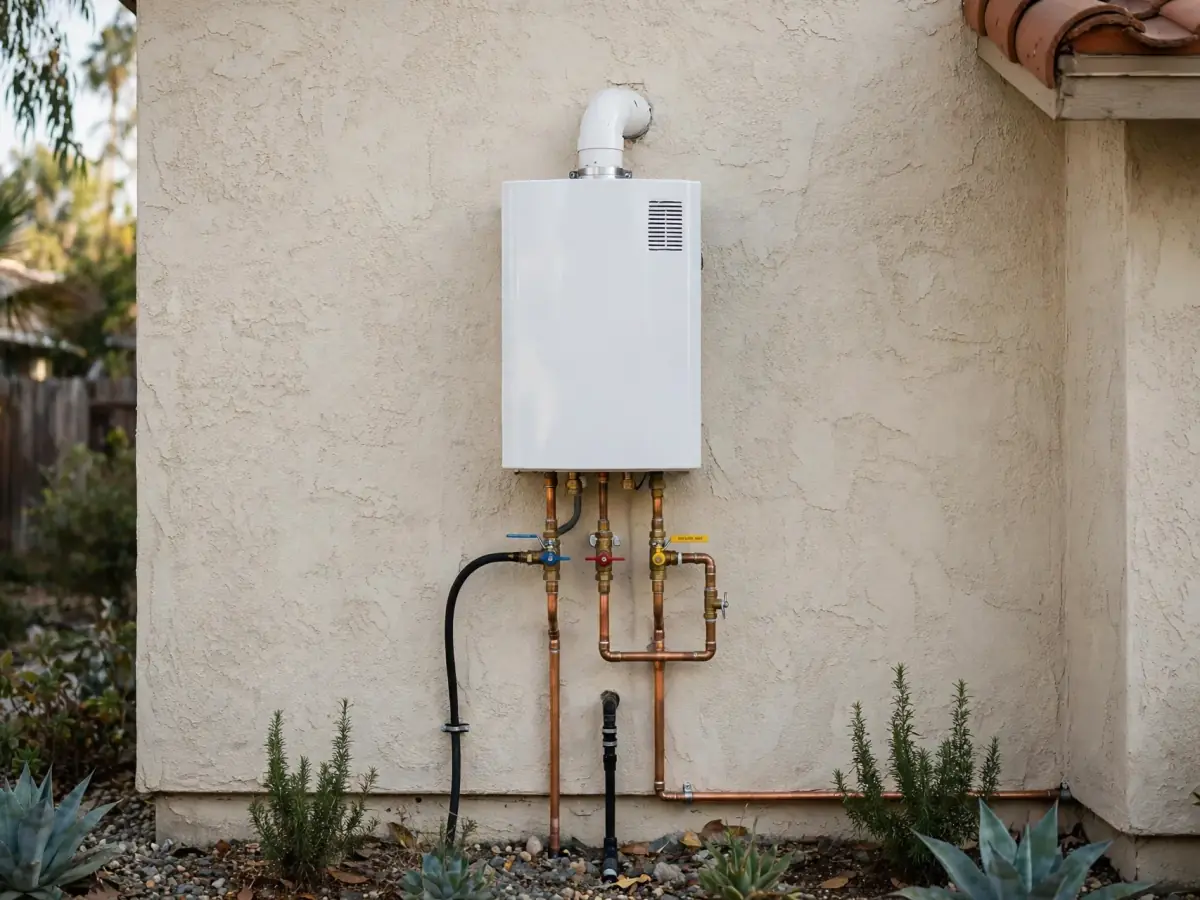
Many Los Angeles tankless heaters are mounted outside on an exterior wall, which frees up space indoors and simplifies venting. Outdoor units are built for it, but they still face sun, wind, sprinklers, salt air near the coast and the occasional curious animal. Faded or cracked covers, corroded fittings at the bottom of the unit, and wiring damaged by pests are all common findings on exterior installs.
Pipe insulation on the water lines below the unit protects against heat loss and the rare cold night, and a cover over the pipes keeps sprinklers off the connections. If the unit sits near a bedroom window, a door or a property line, its vent termination clearances should match the manufacturer's installation manual and local code.
When an outdoor unit shows an ignition or combustion error during strong wind, the plumber looks at the vent termination and intake as well as the parts inside, because wind can disrupt combustion on some installations.
Electric tankless
Electric tankless units have their own limits
Electric tankless heaters avoid gas lines and venting entirely, which makes them attractive for small homes, ADUs and point-of-use installs under a sink. Their limitation is power: a whole-house electric tankless unit draws a very large current, often on several dedicated circuits, and many existing electrical panels cannot support one without an upgrade.
Common electric tankless problems include tripped breakers, burned-out heating elements or chambers, scale on the elements, and flow sensors that stop detecting low flows. [3] Diagnosis involves electrical testing with the power safely managed, so it is work for a qualified professional.
If an electric tankless unit never quite keeps up with a shower in winter, it may be undersized for the temperature rise your incoming water needs, rather than broken. [1]
Water quality
Hard water, softeners and tankless heaters
Scale is the single biggest threat to a tankless heat exchanger, and how fast it builds depends on the hardness of the water reaching your home. Water hardness differs across Los Angeles depending on the source and the supplier, and your utility's annual water quality report lists it. [2] Homes with harder water usually need descaling more often than the minimum the manual suggests.
Some homeowners add a water softener or a scale-reduction cartridge ahead of the tankless unit. These can reduce scale, but they need their own maintenance, and some manufacturers have specific guidance about softened water and warranty coverage. Check the installation manual or ask the plumber before adding treatment equipment.
If a unit has gone years without descaling, the heat exchanger may be heavily coated.
Warranty
Warranty and parts on tankless units
Tankless heaters usually carry separate warranties for the heat exchanger and for other parts and labor, and the terms often depend on proper installation and documented maintenance. Keep records of each descaling and service visit. If the unit fails within the warranty period, the manufacturer may require the repair to be done by a qualified installer.
Parts for tankless units are model-specific. Telling the plumber the brand and model before the visit gives them the best chance of arriving with the right sensor, igniter or board, or of ordering it quickly.
Maintenance
Why scale matters more for tankless units
A tankless heater pushes water through narrow passages in a compact heat exchanger. Minerals that would settle harmlessly at the bottom of a tank coat those passages instead, which reduces heat transfer and makes the unit overheat or throttle its output.
Manufacturers publish descaling intervals in the installation manual, and they generally shorten the interval for harder water. [2] Because hardness differs across Los Angeles, the right schedule for your home depends on your water supplier's report and on how heavily the unit is used.
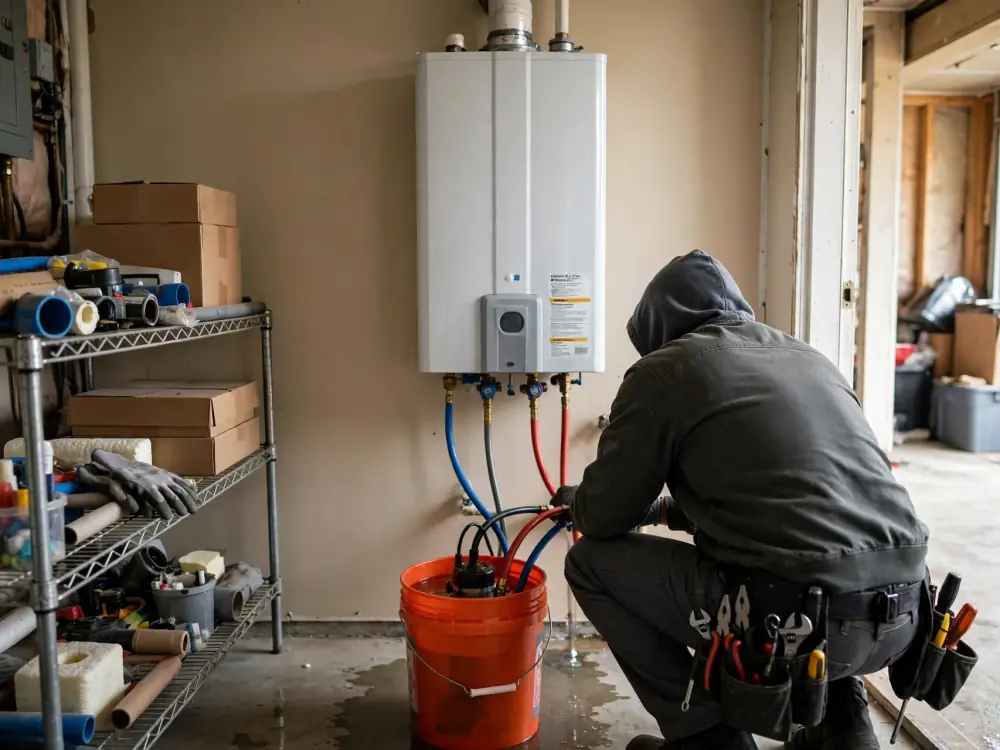
Descaling is done through the isolation valves under the unit: the plumber circulates a descaling solution through the heat exchanger with a small pump, flushes it out, and cleans the inlet filter.
Error codes
What tankless error codes usually point to
Code numbers differ by brand, so check the manual for yours, but most codes fall into a handful of groups.
| Code category | Usual causes | Who should handle it |
|---|---|---|
| Ignition failure or flame loss | Gas supply too low, closed gas valve, dirty flame rod, venting or air intake problems | Plumber; check the gas valve is open first |
| Overheat or heat exchanger | Scale buildup, low flow, failed temperature sensor | Descaling, then a plumber if it returns |
| Fan or combustion air | Failing fan motor, blocked intake or vent termination | Plumber |
| Flow or sensor | Clogged inlet filter, failing flow sensor, very low flow at fixtures | Clean the filter; sensor replacement by a plumber |
| Condensate | Blocked condensate line or neutralizer on condensing units | Plumber |
| Freeze protection | Rare in LA basins; possible at high elevations on exterior units | Plumber |
Write down the exact code and the model number from the label on the side of the unit before you call.
Los Angeles
Gas supply and venting in Los Angeles homes
Many Los Angeles houses were plumbed decades ago for a gas tank heater, a furnace and a range. A whole-house tankless unit can draw far more gas at full fire than an old tank, so when a tankless retrofit was done without checking the gas line size, the unit can starve and shut down when another gas appliance runs at the same time. That pattern, failures only during heavy use, is a strong hint.
Exterior wall-mounted units are popular here because the mild climate allows them. They save interior space and simplify venting, but they live in sun, wind and, near the coast, salty air, so vent terminations and covers deserve a look during any service visit.
Quick checks
What to check before booking a visit
- Confirm other gas appliances work, so you know gas is reaching the house.
- On electric units, check the breaker panel; many tankless units use two or more double-pole breakers.
- Clean the shower head or faucet aerator if the problem is at one fixture only.
- Power-cycle the unit once. If the same code returns, write it down along with the model number from the side label.
Repair or replace
When a tankless unit is worth repairing
Most tankless components, including fans, igniters, sensors, flow switches and control boards, are replaceable, so repair usually beats replacement. Keep the purchase date and descaling records; they matter for warranty claims.
Diagnosis
How a tankless repair is diagnosed
A tankless water heater, also called an on-demand heater, has no storage tank. When a hot tap opens, a flow sensor detects water moving through the unit, the control board starts the fan and igniter on a gas model or the heating elements on an electric one, and a heat exchanger warms the water as it passes. [1] Every one of those steps is monitored by sensors, and when something goes wrong, the board usually stops the unit and shows an error code.
That makes the error code the starting point. The code, the model number and a description of when the problem happens (every time, only at low flow, only when two showers run, only on cold mornings) let a plumber narrow the fault before opening the cover. The manufacturer's service manual explains what each code means for that specific model.
From there the plumber checks the basics that cause most calls: the inlet water filter, the gas supply pressure while the unit is firing, the venting and air intake, the condensate drain on condensing models, and scale in the heat exchanger. Only after those are confirmed does it make sense to test sensors, the flame rod, the igniter, the fan or the control board.
Quick reference
Tankless water heater problems and likely causes
| What you notice | Likely causes | What the plumber checks |
|---|---|---|
| Hot, then cold, then hot again | Low flow below the activation rate, scale, crossed plumbing | Flow rate, inlet filter, fixture aerators, mixing valves |
| Unit shuts down with an error code | Ignition failure, overheating, vent or air problem | Code meaning for the model, gas pressure, venting |
| Water never gets hot enough | Undersized unit, scale, low gas pressure | Temperature rise at current flow, heat exchanger, gas supply |
| Fails when two fixtures run | Demand exceeds the unit's capacity, gas line too small | Unit rating against the household's peak demand, gas line size |
| Water dripping from the unit | Condensate line, relief valve, fitting leak | Condensate drain, relief valve, connections |
| Unit does not respond at all | No power, tripped breaker, failed board or flow sensor | Power at the unit, fuse, flow sensor signal |
| Loud fan or whistling | Fan wear, blocked intake, scale | Fan, intake screen, vent termination |
Cold water sandwich
The cold water sandwich and other flow problems
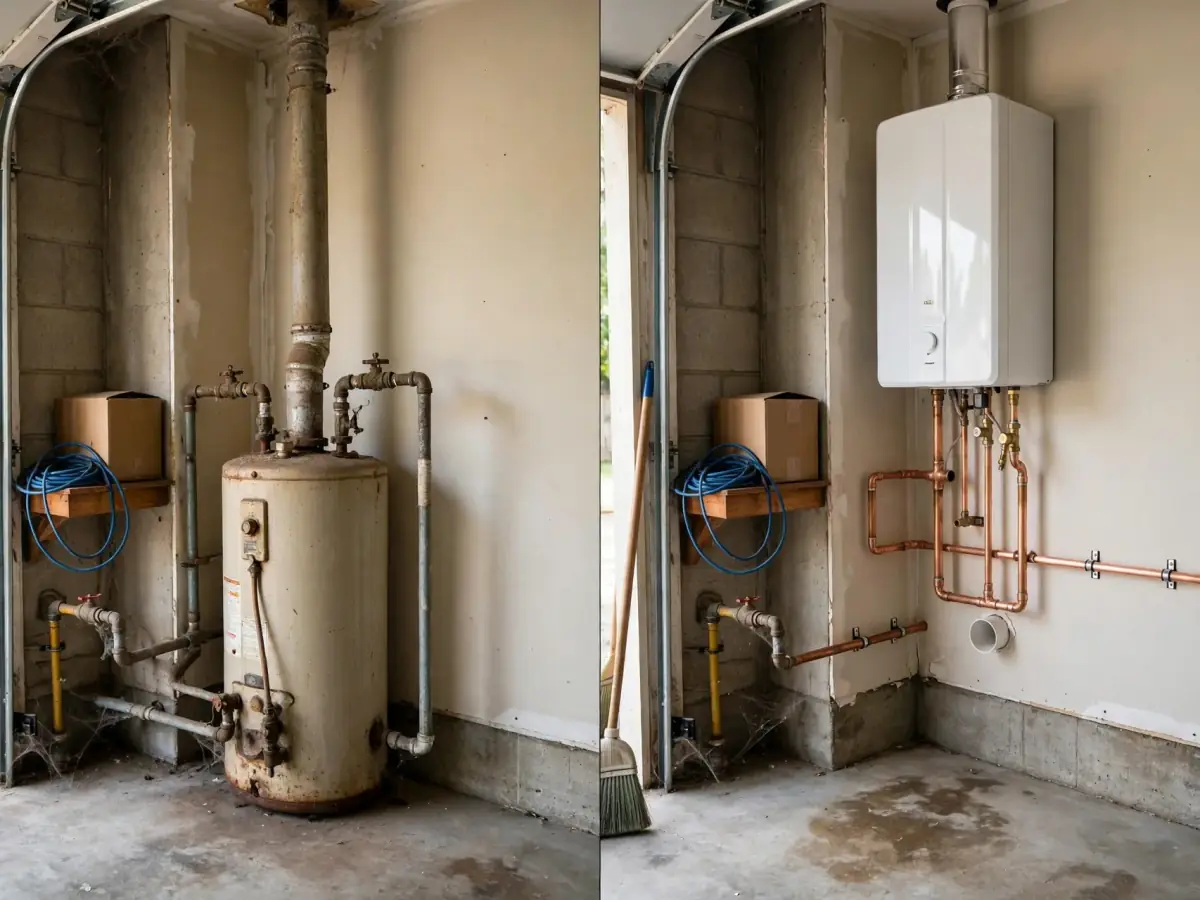
The most common tankless complaint is not a fault at all. When someone showers, turns the water off briefly and turns it on again, the water left sitting in the pipes is hot, the unit has to restart, and a short slug of cold water arrives between the two hot ones. Plumbers call it the cold water sandwich. It is normal behavior for most tankless designs, and the fix is in the plumbing layout or a unit with a small buffer, not a repair.
A different pattern, hot water that fades to cold during a single shower, usually means the flow has dropped below the minimum the unit needs to stay lit. Low-flow shower heads, a clogged aerator, a dirty inlet filter or scale in the heat exchanger can all cause it. Cleaning the inlet filter and descaling often solve it.
Recirculation systems, which keep hot water moving through the pipes so it reaches the tap faster, also affect how a tankless unit behaves. If your home has one, tell the plumber, because its pump and timer settings are part of the diagnosis.
Gas and venting
Gas supply and venting for tankless units
A gas tankless heater burns far more gas per hour while it is running than a tank heater does, because it has to heat water instantly instead of slowly. That means the gas line from the meter has to be large enough to deliver that volume while other appliances are also running. A unit installed on the old tank heater's gas line, without the line being upsized, may work most of the time and fail with an error code when the furnace and stove are on.
Venting is equally specific. Non-condensing units need stainless or other approved high-temperature vent material. Condensing units have cooler exhaust and can often use plastic vent pipe, but they produce acidic condensate that must drain properly, often through a neutralizer. A vent that is the wrong material, too long, or has a blocked termination will cause shutdowns and can be a safety hazard.
These are installation issues, but they show up as repair calls, so a good tankless repair visit includes a check of the gas line size and the vent against the manufacturer's requirements.
Maintenance
Tankless maintenance that prevents most repairs
Tankless units last a long time when they are kept clean. Most failures trace back to skipped maintenance.
Descale on schedule
Follow the manual's interval for your water hardness. Many Los Angeles homes need it yearly. [2]
Clean the inlet filter
A small screen on the cold inlet catches debris. A clogged one reduces flow and triggers shutdowns.
Keep vents clear
Check the vent and air intake outside for nests, leaves and plants growing too close.
Watch the condensate
On condensing models, make sure the condensate line drains freely and the neutralizer is serviced.
Note error codes
Write down any code with the date. A pattern of the same code tells the plumber a lot.
Protect outdoor units
Exterior units near the coast or in direct sun benefit from a check of the cover, wiring and seals.
Before the visit
What to tell the plumber about a tankless unit
Tankless models vary widely. These details help the plumber arrive prepared.
- Brand and modelA photo of the label on the side of the unit, plus whether it is indoor or outdoor, gas or electric.
- The error codeThe exact code shown on the display or controller, and when it appears.
- When it happensEvery use, only at low flow, only with two fixtures running, or after a recent change such as a new shower head or water softener.
- Service historyWhen the unit was last descaled and whether it is still under the manufacturer's warranty.
Records
Keeping a tankless service log
Write down each descaling date, filter cleaning and error code with the date it appeared. That log supports warranty claims and shows the plumber patterns at a glance.
FAQ
Tankless repair questions
Is a tankless unit worth repairing?
Usually, yes. Heat exchangers, sensors, fans and igniters are replaceable parts, and many units carry long heat-exchanger warranties. A unit with a cracked heat exchanger outside warranty is the main case where replacement wins.
Can any plumber repair a tankless heater?
Basic descaling is widely offered, but diagnosing error codes and replacing control boards goes better with someone who works on your brand regularly. Ask which brands the technician services before the visit.
Will repairs affect my warranty?
Manufacturers often require installation and certain repairs to be done by a licensed professional and may ask for proof of regular maintenance. Keep descaling receipts with the unit's paperwork.
How often should a tankless water heater be descaled?
Follow the interval in the manufacturer's manual, which usually shortens for harder water. Because hardness varies across Los Angeles, your water supplier's quality report helps decide whether yearly service is enough.
Why does my tankless water heater go cold in the middle of a shower?
Usually the flow has dropped below the minimum the unit needs to stay lit, from a low-flow shower head, a clogged filter or scale. Another cause is too many fixtures running for the unit's size.
What does an error code on my tankless heater mean?
Each brand uses its own codes, listed in the owner's or service manual. Note the exact code and model number before you call; it helps the plumber diagnose faster.
Who repairs tankless water heaters in Los Angeles?
A licensed plumber familiar with tankless units. Call the number on this page and a plumber will ask about the brand, model and error code before the visit.
Why is my tankless water heater not turning on?
Check that it has power and that the gas and water valves under it are open. If it still will not start, the flow sensor, a fuse, the igniter or the control board may be at fault, which needs a plumber.
Can a tankless water heater freeze in Los Angeles?
It is rare, but outdoor units on cold nights can be at risk if power is lost. Most have built-in freeze protection that only works with power on, and insulated pipes help.
How long does a tankless repair visit take?
A descale or filter cleaning typically takes about an hour or two. Repairs that need a model-specific part can require a second visit if the part has to be ordered.