Key facts: Downtown and Koreatown
- Buildings use either a heater per unit or a central system with a recirculation loop; that decides who fixes it.
- California law lists hot and cold running water among habitability requirements for rentals [1].
- Many older buildings fall under LA's Rent Stabilization Ordinance, administered by the Housing Department [2].
- Replacing a water heater in the City of LA is permitted work through LADBS [3].
Dense housing
How hot water works in these buildings
Buildings here heat water in one of two ways. Many condos and newer apartments give each unit its own water heater, usually an electric tank or a compact unit in a closet. Many older apartment buildings and some large complexes use a central system instead: one or more large heaters or a boiler in a utility room, with a recirculation loop that keeps hot water moving to every unit.
The setup decides who handles a problem. With a unit heater, the condo owner, or the landlord for a rental, arranges the repair. With a central system, the building's owner or association maintains it, and a single cold apartment often points to a mixing valve, a circulation pump or a balancing issue rather than the main heaters.
Who handles it
Who to contact when the hot water stops
| Your situation | Who usually handles it | What to do first |
|---|---|---|
| Renter, any building | The landlord or property manager | Report it in writing to the manager or owner |
| Condo owner with a heater in your unit | You, following association rules | Check HOA rules for contractors and access |
| Condo owner, central building system | The association | Report it to the management company |
| Owner of a small apartment building | You, for building heaters | Call a licensed plumber; tenants are waiting on hot water |
Renters
Hot water and California rental law
California's Civil Code lists hot and cold running water among the basic requirements for a habitable rental home, and keeping the water heater working is normally the landlord's responsibility. [1] Many older buildings in these neighborhoods also fall under the City of Los Angeles Rent Stabilization Ordinance, administered by the Los Angeles Housing Department, which also handles complaints about required services. [2]
If you rent, report a lack of hot water to your landlord or manager promptly, preferably in writing. This site connects calls with independent plumbers, so owners and managers can use it to arrange the repair; it cannot give legal advice about tenant rights.
Common calls
What plumbers see most in these buildings
Electric closet heaters
Condo units often have small electric tanks in closets, where failed elements and leaks onto floors below are the main concerns.
Central system faults
Building-wide lukewarm water can mean a failed heater in a bank, a recirculation pump problem or a mixing valve set wrong.
Leaks between floors
A slow leak in one unit can show up as a stain in the ceiling below before anyone notices the heater.
Access and scheduling
Loading docks, elevators, parking and HOA work hours all need planning before a replacement.
Tips
Tips for owners and managers
- Keep a record of each unit heater's age so replacements can be planned before failures.
- Fit drain pans and leak sensors on heaters above other units.
- For central systems, have the recirculation pump and mixing valves checked during routine service.
- Share building access, parking and elevator arrangements with the plumber when booking.
Central systems
Troubleshooting a central hot water system
When a building with a central system has complaints about lukewarm water, the cause is often not the heaters themselves. A failed recirculation pump lets water in the loop cool, so units far from the utility room wait a long time for hot water. A thermostatic mixing valve set too low, or failing, can make every unit lukewarm at once. Sediment in one heater of a bank can reduce total capacity during the morning rush.
A plumber working on a central system will usually check the heater temperatures, the mixing valve output, the pump and the loop return temperature before replacing anything. That approach finds the real cause and avoids replacing heaters that are still sound.
Planning
Planning replacements across a building
Planned work can be scheduled around residents, permits can be pulled in advance, and leak damage between floors becomes much less likely. [3]
For central systems, a replacement is a larger project that may include new heaters, pumps, valves and controls. It deserves a proper assessment of the building's actual demand rather than simply matching the old equipment.
Older buildings
Older apartment buildings and their plumbing
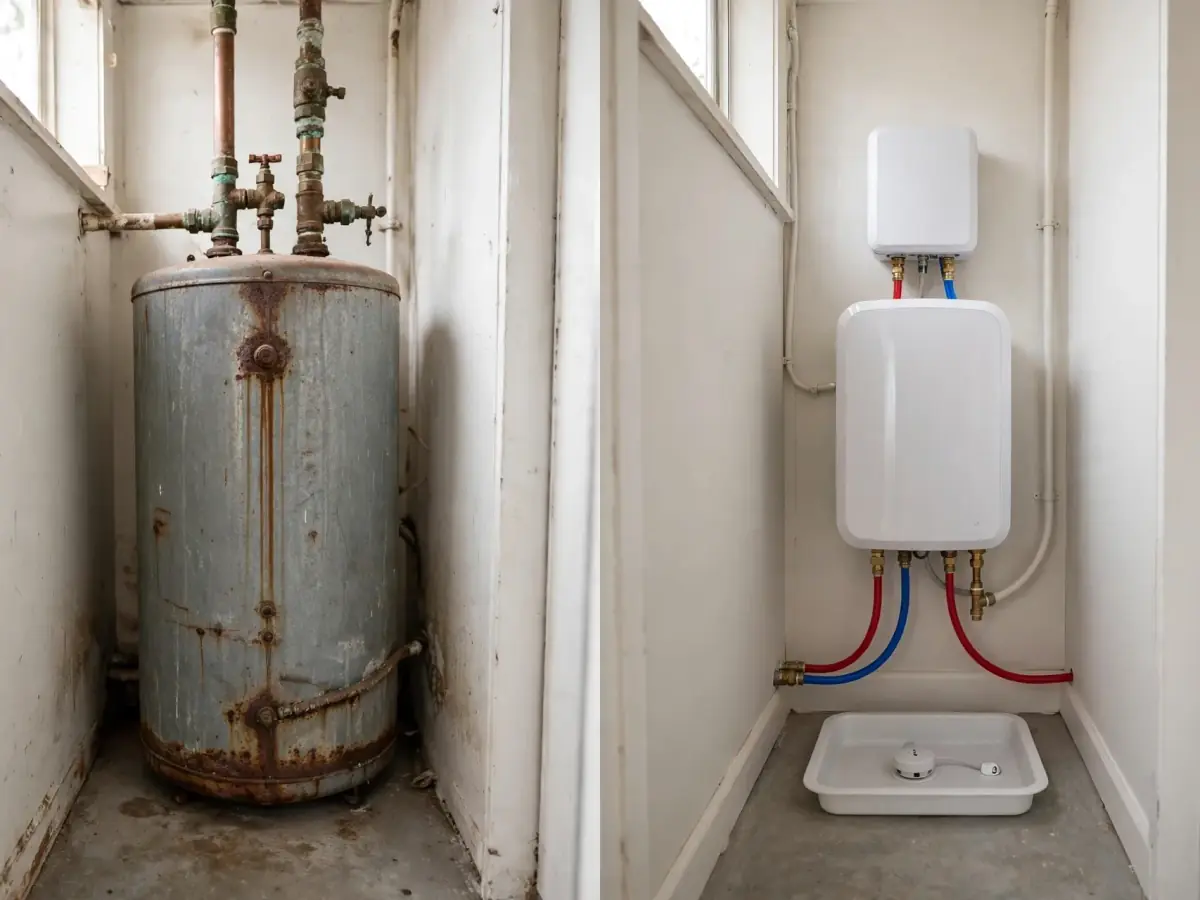
Koreatown and Mid-Wilshire have many apartment buildings from the 1920s through the 1960s. Over the decades, their hot water systems have often been modified: original boilers replaced with banks of tank heaters, recirculation loops added or removed, and supply piping partly replaced. That history can make problems harder to diagnose, because the system may not match any drawing.
When a building has persistent hot water complaints, a plumber who maps the system, checking which heaters feed which risers, where the mixing valve is and how the loop returns, can usually find the cause and suggest a fix that addresses the whole building rather than one unit at a time.
Coverage
Central LA neighborhoods covered by this service
The plumber confirms availability for your exact address when you call.
- Downtown Los AngelesConverted historic office and loft buildings, high-rise apartments and condos, with central plants, unit tankless heaters and small electric tanks.
- KoreatownOne of the densest neighborhoods in the city, with 1920s apartment buildings, 1960s and 1970s complexes and newer mid-rises.
- Westlake and MacArthur ParkOlder apartment buildings, many with central boilers or rows of unit heaters in basement rooms.
- Mid-Wilshire and Pico-UnionDuplexes, fourplexes and apartment buildings, with a mix of individual and shared water heaters.
Lofts
Downtown lofts and adaptive reuse buildings
Many Downtown residences are in buildings that began life as offices, banks or factories and were converted to housing under the city's adaptive reuse rules. Water heating in these buildings was added during the conversion, so it varies a great deal: some have a central plant in the basement, others have a small electric tank or tankless unit in each loft, often tucked into a closet or above a ceiling.
In-unit heaters in lofts are frequently in tight or awkward places, which matters for repair and replacement. Know where your heater is, whether it is electric or gas, and whether the building or association has rules on who may work on it.
A unit heater above a ceiling or in a closet next to a neighbor's wall makes leak protection especially important.
Koreatown buildings
Koreatown's 1920s apartment buildings
Koreatown has a large concentration of 1920s and 1930s apartment buildings, many with original layouts and decades of plumbing changes. Some still run on a central boiler or large storage heater in the basement, with long pipe runs to upper floors. Others were converted to individual unit heaters during remodels, sometimes with heaters in kitchens or hallway closets that were never designed for them.
In these buildings, a hot water complaint often has more to do with the distribution system than the heater: a recirculation pump that has failed, a mixing valve that has drifted, or old galvanized pipe restricting flow. A plumber experienced with multi-unit buildings starts by finding out whether one unit or many are affected and at what times of day.
Quick reference
Building water heater problems and first steps
| What you notice | Common cause in these buildings | What to do first |
|---|---|---|
| No hot water in one unit | That unit's own heater, or a valve on its branch | Tell the manager in writing; note when it started |
| Lukewarm water building-wide in the morning | Central heater capacity, recirculation pump or mixing valve | Manager calls the building's plumber |
| Hot water takes minutes to arrive upstairs | Failed recirculation pump or timer | Report to the manager |
| Water dripping from a ceiling | Leak from a heater or pipe above | Tell the manager immediately; move valuables |
| Very hot water at some taps | Mixing valve failure on a central system | Use care; report to the manager urgently |
Owners
Recordkeeping and planning for building owners
For owners of multi-unit buildings, water heaters are a predictable expense.
Central systems benefit from regular service: flushing storage tanks, checking recirculation pumps and mixing valves, and testing relief valves. For buildings with unit heaters, replacing several at once in a planned project is usually more economical than replacing them one at a time as they fail.
Water heater replacements in the City of Los Angeles need a permit from LADBS, and work in a rent-stabilized building may involve additional notice requirements to tenants. [2] [3] Check the current rules before scheduling large projects.
Resident tips
Tips for apartment and condo residents
What residents can do while waiting for a repair.
Report in writing
Email or text your manager with the date, time and what you notice. Keep a copy.
Know the shut-off
Find the cold-water valve above an in-unit heater before you need it.
Do not touch central equipment
Boiler rooms and central heaters are the building's responsibility.
Watch for leaks
A wet closet floor or stain on a ceiling should be reported right away.
Test smoke and CO alarms
Especially if your unit has a gas heater or is near a boiler room.
Ask about timing
Ask the manager when a plumber is booked and whether water will be shut off.
Central systems
How a central hot water plant works
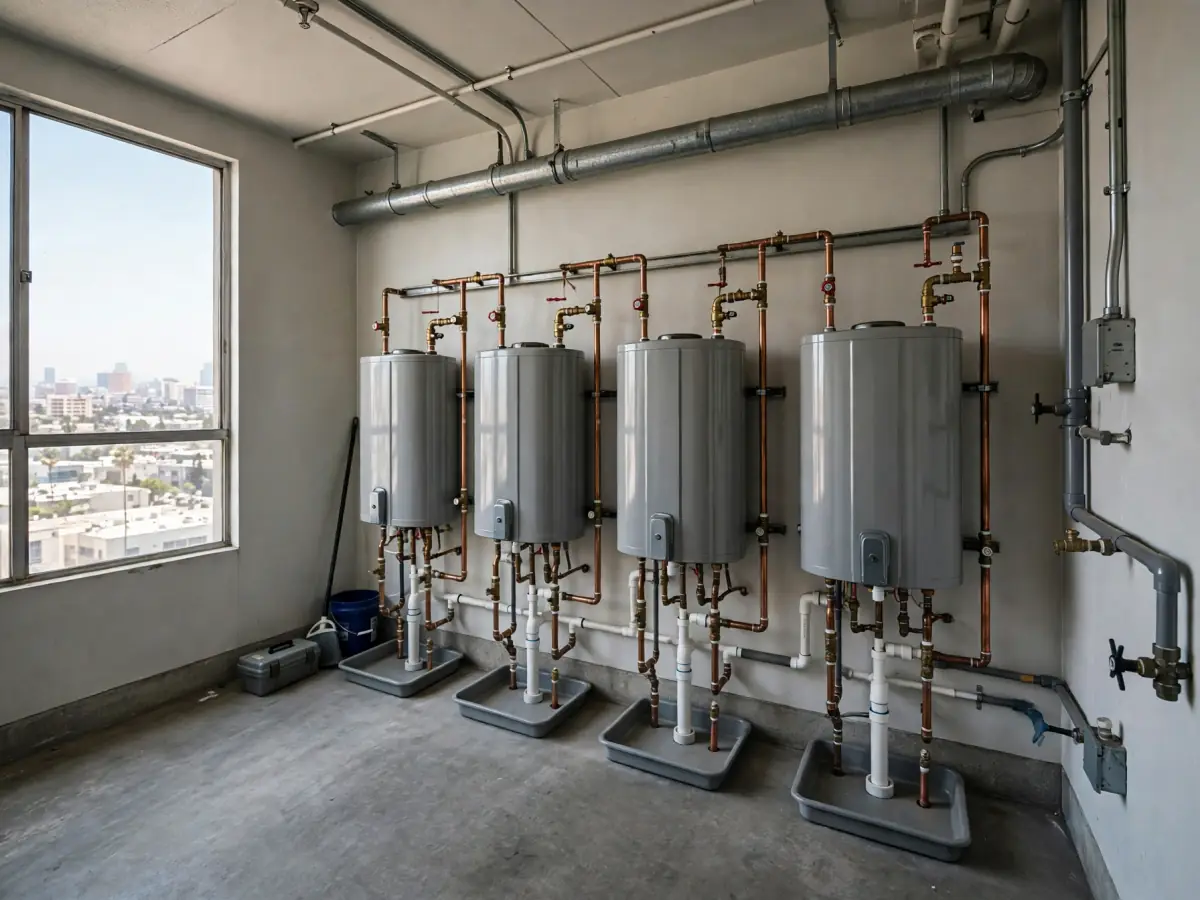
In a building with a central system, one or more large water heaters or boilers heat water in a basement or utility room, often with a separate storage tank. A recirculation pump keeps hot water moving through a loop that runs up through the building and back, so hot water arrives quickly at every unit. A master mixing valve blends hot and cold water to a safe delivery temperature.
Each part can fail in its own way. A heater that cannot keep up gives lukewarm water at peak times. A failed recirculation pump means long waits for hot water on upper floors. A mixing valve that drifts can deliver water that is too cool or dangerously hot. A plumber who works on commercial and multi-unit systems checks each part in turn.
Residents cannot see any of this, which is why describing the timing and location of a problem is so useful to the building manager and the plumber.
Westlake and Pico-Union
Westlake, MacArthur Park and Pico-Union
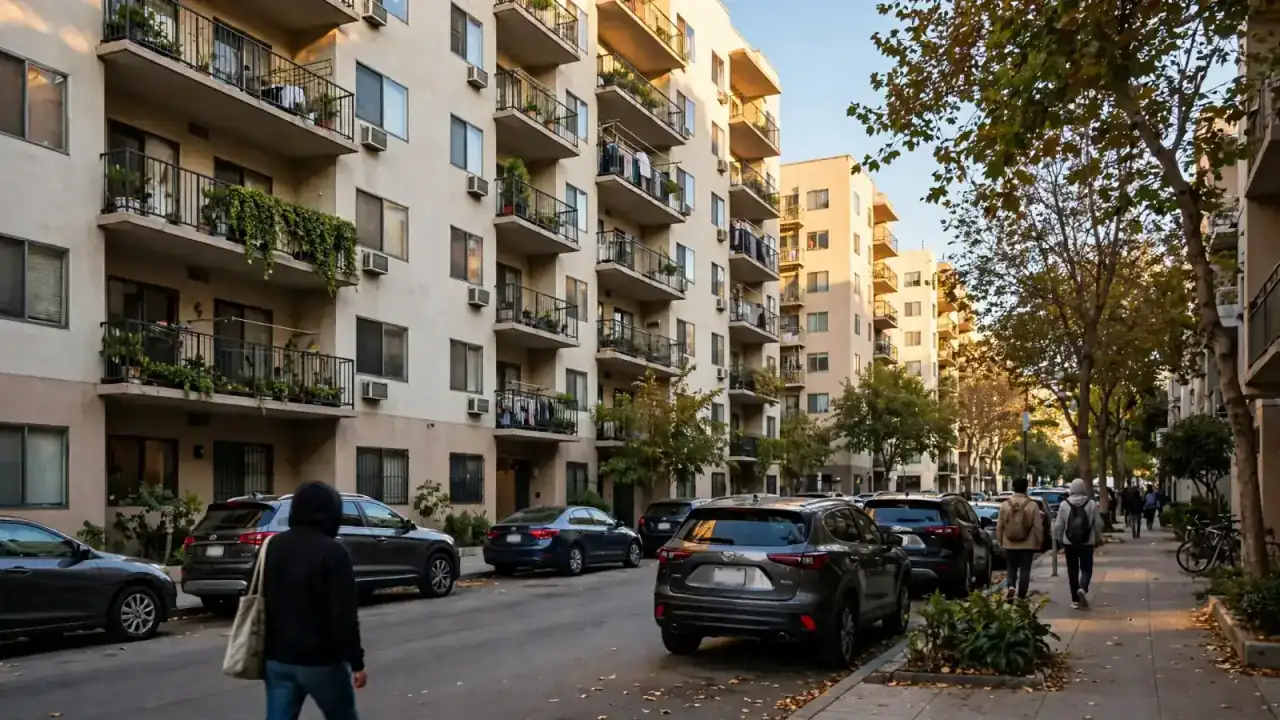
West of Downtown, Westlake and Pico-Union have many older apartment buildings and small multi-unit properties with heavily used water heaters. In some buildings, rows of unit heaters sit together in a basement or ground-floor utility room; in others, a single central heater serves every apartment.
These neighborhoods also have many duplexes and small courts where one owner manages a few heaters. For those owners, the same rules apply as anywhere: keep track of the age of each heater, test relief valves, check that every heater is strapped and has a safe relief discharge, and plan replacements before leaks. Tenants should report hot water problems in writing and keep a copy.
Safety
Gas safety in older apartment buildings
Gas water heaters in apartment closets and basement rooms need adequate combustion air and a sound vent. In older buildings, years of remodeling can leave a heater in a closet that has been made smaller, sealed with a solid door, or filled with storage. Each of those changes can starve the flame and push exhaust into the living space.
Signs of trouble include soot around the top of the heater, a smell of exhaust, condensation on walls near the heater and a pilot that keeps going out. Carbon monoxide alarms are required in many California homes with gas appliances and should be tested regularly. If an alarm sounds, get everyone outside and call 911.
If you smell gas, leave the building without operating switches or elevators, and call the gas utility or 911 from outside.
Mid-Wilshire
Mid-Wilshire duplexes and fourplexes
Around Mid-Wilshire and the streets south of Koreatown, many blocks are lined with 1920s duplexes and fourplexes. Each unit usually has its own water heater, sometimes in a service porch at the back, sometimes in a closet off the kitchen, and sometimes all together in a shared space at the rear of the lot.
Owners of these buildings face the same questions as owners of larger properties, on a smaller scale. A heater that serves an upstairs unit can damage the unit below if it leaks, so a drain pan with a drain line is especially important. Relief valve lines should run to an approved spot outside rather than ending in a closet, and every heater needs two straps into the framing.
When a duplex or fourplex has heaters of very different ages, replacing the oldest before they fail avoids emergency calls and tenant disruption.
New buildings
Newer mid-rise and high-rise buildings
Newer apartment and condo buildings in Downtown and Koreatown often use compact electric tanks or tankless heaters in each unit, or high-efficiency central plants. In-unit equipment is usually in a small mechanical closet, sometimes alongside the air handler, and access panels can be tight.
Residents in these buildings should contact the management office first. Many buildings have a service contract, and outside contractors may need approval, insurance documents and a scheduled time.
Inspections
Water heaters and building inspections
Multi-unit buildings in Los Angeles are subject to periodic inspections, and water heaters are among the items inspectors look at: seismic strapping, relief valve discharge, venting for gas units and clearance around the heater. Keeping every heater in a building up to standard makes these inspections routine and avoids correction notices that have to be cleared on a deadline.
FAQ
Questions from apartment and condo residents
My neighbors have hot water but I don't. Is it the building?
If your unit has its own heater, the problem is probably that heater. If the building has a central system, a valve or balancing issue in your unit's branch is more likely, and the building manager should arrange the repair.
How long can a landlord take to restore hot water?
There is no single number in every case. Lack of hot water is a habitability issue, so it should be treated as urgent. The Los Angeles Housing Department provides information and handles complaints for covered units.
Can I replace my condo's water heater with a tankless one?
Sometimes. It depends on the building's electrical or gas capacity, venting options and the association's rules. Electric tankless units for a whole condo can require a large electrical supply.
Do Downtown and Koreatown repairs need a permit?
Replacing a water heater is permitted work in the City of Los Angeles, issued by LADBS. Repairs such as replacing an element or valve usually are not.
Can tenants call a plumber themselves?
Tenants should normally report the problem to the landlord or manager, who arranges repairs. Hiring a plumber directly can create disputes about payment and access. The Los Angeles Housing Department explains the options when required services are not restored.
Who fixes the water heater in my Koreatown apartment?
Usually your landlord or property manager arranges and pays for the repair. Report the problem in writing first.
Why is there no hot water in my whole building?
Most often a central heater, recirculation pump or mixing valve problem. The building owner or manager needs to call a plumber.
Can I call a plumber myself for my condo heater?
If the heater serves only your unit and is your responsibility under the association rules, yes. Check the rules on licensed and insured contractors first.
How long can a landlord take to fix the hot water?
California law requires a reasonable time after written notice, and the right timeline depends on the circumstances. The Los Angeles Housing Department can explain tenant options if a repair is delayed.
Why is the hot water in my building too hot at times?
A central mixing valve may be failing. Use care at the tap and report it to the manager urgently, since very hot water can scald.
Who fixes the hot water in a Downtown loft?
If the heater serves only your unit, check your lease or association rules. Renters contact the manager; owners may hire a licensed plumber, following building rules.
Why does my Koreatown apartment take long to get hot water?
In older buildings, long pipe runs or a failed recirculation pump are common causes. Report it to the manager, noting the time of day.
Can a building replace all its unit heaters at once?
Yes. Owners often replace aging unit heaters in one planned project, which reduces disruption for residents. Each heater still needs its own permit.
Who checks the water heaters in my apartment building?
The owner or manager is responsible for maintenance, and city inspectors look at water heaters during periodic building inspections. Report any problem to the manager in writing.