Key facts: Gas Water Heater Repair
- On standing-pilot gas heaters, a thermocouple must sense the pilot flame or the gas valve shuts off, the most common cause of a pilot that won't stay lit.
- Gas water heaters made since the mid-2000s use a sealed, flammable-vapor-resistant combustion chamber whose air screen can clog with lint and dust.
- A yellow, lazy burner flame signals poor combustion, which can produce carbon monoxide [4].
- California requires water heaters to be strapped against earthquakes [2].
How it works
What is inside a gas water heater
A standard gas tank heater is simple. Cold water enters through a dip tube that delivers it to the bottom of the tank. [1] A burner under the tank heats it, and the exhaust rises through a flue running up the center of the tank and out through the vent. [4] A gas control valve on the front reads the water temperature and opens or closes the gas to the burner.
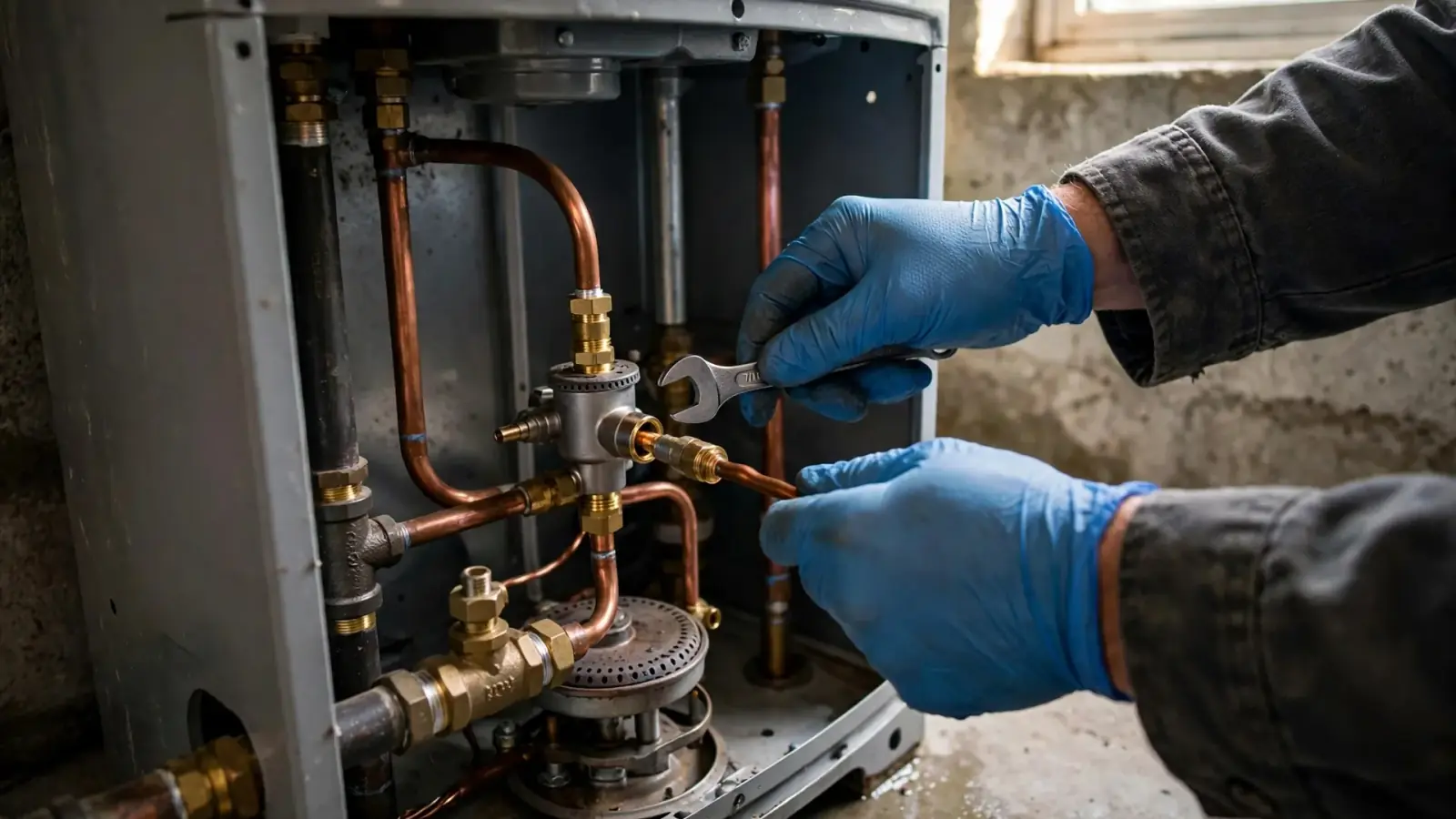
A pilot flame, or on newer models an electronic igniter, lights the burner. On standing-pilot models a thermocouple or thermopile sits in the pilot flame and produces a tiny electrical signal that tells the gas valve the pilot is lit. If that signal disappears, the valve shuts off the gas. That safety feature is why so many no-hot-water calls start with a pilot that will not stay lit.
Every gas tank heater made for residential use since the mid-2000s also has a flammable vapor ignition resistant (FVIR) design: a sealed combustion chamber with a flame arrestor screen underneath that keeps fumes from spilled gasoline or solvents in a garage from reaching the flame. It is an important safety improvement, and it adds one more part that can clog and starve the burner of air.
Signs
Signs your gas water heater needs a repair
These are the symptoms that most often lead to a service call on gas units.
Pilot will not stay lit
It lights, then goes out when you release the knob, or it dies a few hours later. The thermocouple, pilot tube or a clogged flame arrestor are the usual causes.
Read moreBurner will not ignite
The pilot is lit but the main burner never comes on. A failed gas control thermostat or a blocked burner orifice is likely.
Not enough hot water
Sediment insulating the tank bottom, a broken dip tube or a temperature setting knocked low can all cut capacity.
Read moreYellow, lazy flame
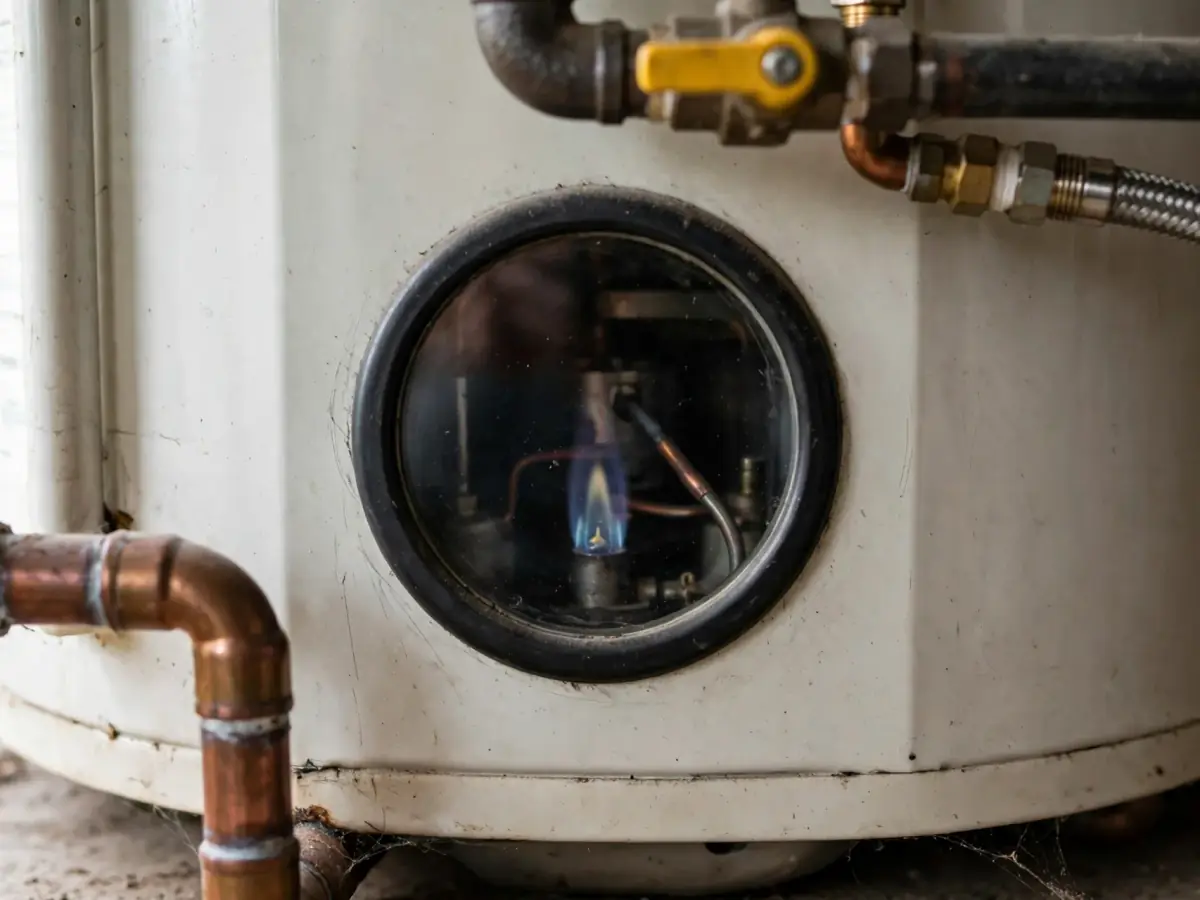
A healthy burner flame is mostly blue. A yellow flame means poor combustion and needs attention because it can produce carbon monoxide.
Soot or scorch marks
Black marks around the burner door or the top of the heater point to flame rollout or a blocked vent, both safety problems.
Exhaust smell or condensation
A vent that is disconnected, too long or blocked can spill exhaust into the room instead of drawing it outside.
The repair
How a gas water heater repair is done, step by step
- 1
Safety and history
The plumber confirms there is no gas odor, asks what changed, and reads the rating plate for the model, fuel type and age.
- 2
Combustion check
They watch the pilot and burner, check the flame color, inspect the flame arrestor and confirm the vent is drawing properly.
- 3
Component tests
The thermocouple or thermopile output is measured, and the gas control is tested before anyone replaces a part.
- 4
Fix and verify
After the repair, the heater runs a full cycle while the plumber checks draft at the vent, gas connections for leaks and the final water temperature.
Parts
Common gas water heater repairs
The parts that fail most often, what they do, and whether the repair usually makes sense.
| Part | What it does | Usually worth repairing? |
|---|---|---|
| Thermocouple or thermopile | Proves the pilot is lit so the gas valve stays open | Yes. |
| Pilot assembly | Holds the pilot, igniter and sensor together on FVIR models | Yes, if the tank itself is sound |
| Flame arrestor and burner | Lets air in while blocking flammable vapors; burns the gas | Cleaning is routine; a damaged arrestor may mean a new heater on some models |
| Gas control valve | Regulates gas and water temperature | Ask the plumber on the visit |
| Dip tube | Sends cold water to the bottom of the tank | Ask the plumber on the visit |
| Vent connector | Carries exhaust to the flue or chimney | Always fix; a bad vent is a carbon monoxide risk |
Do it yourself?
What you can safely do, and where to stop
A homeowner can do a few things. Anything involving gas connections, venting or the burner assembly belongs to a professional.
- Fine to doRelight the pilot following the instructions printed on the heater, check that the gas control is set to On rather than Pilot or Vacation, and keep the area around the heater clear of storage.
- Fine to doLook at the flame through the sight glass. Note its color and whether the burner lights at all; that tells the plumber a lot.
- Stop hereDo not take apart the burner assembly, bend the pilot tube, or replace the gas valve. FVIR combustion chambers are sealed for a reason.
- Stop hereDo not keep relighting a pilot that goes out repeatedly. Something is shutting it off, and repeated relighting just hides the cause.
Los Angeles
Gas heaters in Los Angeles homes
Much of Los Angeles sits on Southern California Gas Company service, and gas tank heaters in garages are the most common setup in single-family homes. Garage heaters bring their own rules: California requires every residential water heater to be braced or strapped against earthquake movement, and older gas heaters in garages were set on stands so the flame sat above the floor where gasoline vapor collects. [2]
Many houses also have a seismic gas shut-off valve or an excess-flow valve at the meter or on the appliance line. [3] After an earthquake, a shut-off valve can close and leave every gas appliance without fuel. If the pilot went out right after a tremor, check whether the valve tripped before assuming the heater has failed; resetting it and relighting appliances is often a job for your gas utility or a plumber.
Diagnosis
Reading the symptoms before anything is replaced
Gas water heaters give clear clues if you know where to look, and a careful plumber spends the first part of the visit reading them rather than reaching for a new part. The questions are simple: does the pilot light at all, does it stay lit after the knob is released, does the main burner come on when the tank calls for heat, and what does the flame look like when it does?
Each answer narrows the field. A pilot that will not light at all points toward the gas supply, the pilot orifice or the igniter. A pilot that lights but dies when the knob is released points toward the thermocouple, its connection at the valve, or a weak pilot flame that does not heat the sensor enough. A pilot that stays lit while the burner never fires points toward the thermostat side of the gas control valve or a blocked burner orifice.
The flame itself tells the rest of the story. A crisp blue flame with small yellow tips is normal. A tall, lazy, yellow flame, soot on the burner door, or a flame that lifts off the burner ports means the heater is not getting the right mix of gas and air. That is a safety condition, not a comfort complaint, because incomplete combustion produces carbon monoxide. [4]
Quick reference
Gas water heater symptoms and likely causes
A plain-language guide to what the plumber will test first. It is a starting point for the conversation, not a substitute for testing.
| What you notice | Likely causes | What the plumber checks |
|---|---|---|
| Pilot will not light at all | Gas supply off, blocked pilot orifice, failed igniter | Gas cock and meter, igniter spark, pilot tube |
| Pilot lights, then goes out when released | Weak thermocouple signal or loose connection | Thermocouple millivolt output and the fitting at the valve |
| Pilot goes out hours later | Dirty flame arrestor, draft problem, weak pilot flame | Arrestor screen, vent draft, pilot flame shape |
| Pilot on, burner never fires | Gas control thermostat fault, blocked burner orifice | Thermostat response and burner orifice |
| Runs out of hot water quickly | Sediment, broken dip tube, low setting | Drain sample, dip tube, temperature dial |
| Rumbling or popping while heating | Sediment boiling under a layer of scale | Tank bottom sediment and flush results |
| Water on the floor | Relief valve, fittings, drain valve or the tank | Where the water starts, top to bottom |
Venting
Why the vent matters as much as the burner
An atmospheric gas water heater, the most common type in Los Angeles garages and closets, relies on hot exhaust rising up the flue and out through the vent on its own. Nothing pushes it. That works only when the vent connector is the right size, slopes upward toward the flue, has tight joints and is not blocked by a bird nest, debris or a crushed section.
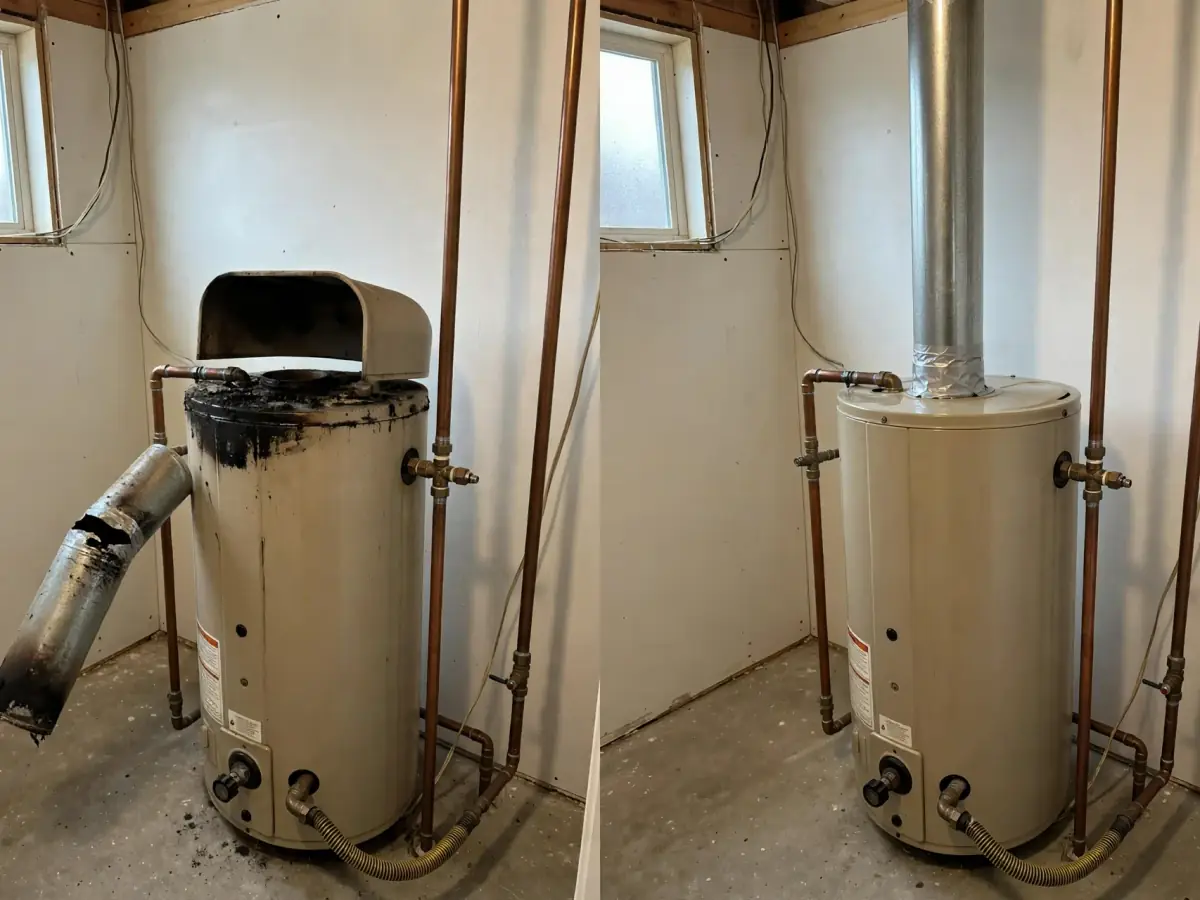
When draft fails, exhaust spills out at the draft hood on top of the heater instead of going up the vent. Signs include soot around the draft hood, moisture or rust on the top of the tank, a smell of exhaust in the garage, and a pilot that keeps going out because it is being starved of fresh air. A plumber checks draft with the heater running, usually with a small flame or smoke source at the draft hood. [4]
Vent problems are never a do-it-yourself fix and never something to live with. If the heater shares a vent with a furnace, both appliances have to work correctly together, and a change to one can affect the other. Install carbon monoxide alarms near any gas appliance, and test them.
Earthquakes
Gas heaters, seismic straps and earthquake shut-off valves
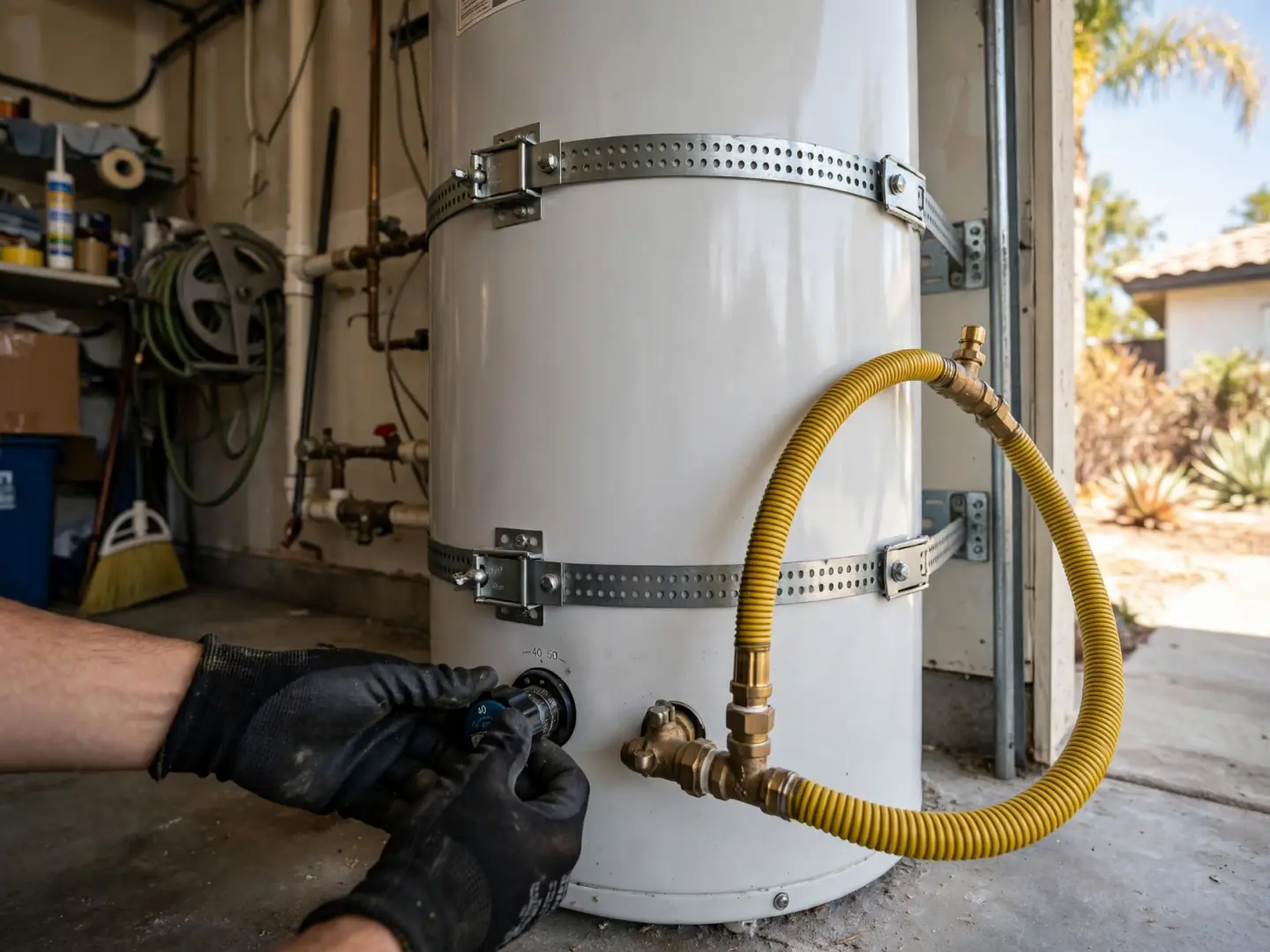
California law requires water heaters to be braced, anchored or strapped to resist falling or moving in an earthquake. [2] On a gas heater this matters twice over: a tank that shifts can pull apart its gas connection and its vent at the same moment. Two straps, one in the upper third and one in the lower third of the tank, fastened into the wall framing, are the standard approach, and a flexible gas connector gives the line room to move without breaking.
Many Los Angeles homes also have an automatic seismic gas shut-off valve at the meter. After a strong shake, it can close and cut the gas to every appliance in the house. If the water heater, stove and furnace all stop at once after an earthquake, that is the likely reason. Do not reset it yourself if you smell gas; contact the gas utility or a licensed plumber. [3]
When a plumber works on a gas heater for any reason, it is a good moment to check the straps, the gas connector and the vent. Old installations often have a single strap, a rigid gas pipe, or a vent connector that was disturbed and never refastened.
Maintenance
Simple habits that keep a gas heater running
Most gas heater failures are gradual. A little attention once a year catches the slow ones early.
Flush once a year
Draining a few gallons from the valve at the bottom removes loose sediment before it hardens. Hard water areas may need it more often.
Read moreKeep the base clear
Boxes, rags and lint near the bottom of a FVIR heater clog the flame arrestor and starve the burner of air.
Exercise the relief valve
Lifting the lever briefly once a year confirms it opens and reseats. If it keeps dripping afterward, have it replaced.
Read moreCheck the anode
Every few years, an anode inspection shows how much protection the tank has left. Replacing a worn rod can add years.
Read moreLook at the flame
A quick look through the sight glass when the burner fires tells you whether the flame is still mostly blue.
Watch the vent
Make sure the vent connector is still attached and sloped up toward the flue, especially after work in the garage.
Where it lives
Garage, closet and exterior gas heaters
Where a gas heater sits changes how it fails and how it is repaired. In a Los Angeles garage, the heater is usually raised on a platform or protected from vehicles, and dust, lint from a dryer and stored items near the base are the main enemies of the flame arrestor. In an interior closet, the concern shifts to combustion air: the closet door or walls need openings sized for the burner, and a closet that has been sealed up or crammed with storage can starve the flame.
Heaters in exterior cabinets, common on older bungalows and some apartment buildings, face wind that can blow out a pilot, rain and sprinkler water that rust the burner area, and pests that nest in the cabinet. Each location has its own checklist, and a plumber who knows the setup can usually tell from the photo you send which parts to bring.
If a heater was moved, enclosed or had a closet built around it after it was installed, mention it when you call. Changes like these are a common cause of pilot and draft problems that appear years after an install that once worked well.
Repair or replace
When a gas heater repair stops making sense
A thermocouple, pilot assembly or dip tube is worth replacing on almost any tank that is not leaking.
A leaking tank is the one problem with no repair. Once water is coming from the tank body itself rather than a fitting or valve, the steel has corroded through, and the only fix is a new heater. Rust-colored water from the hot side only, and water pooling under the burner area, are common early signs.
With the age of the tank and its history in front of you, the right choice is usually clear.
Before the visit
What to tell the plumber about a gas heater
A few details help the plumber arrive with the right parts and diagnose faster.
- Age and modelThe rating plate on the side of the tank lists the brand, model, capacity and often a serial number that encodes the manufacture date. A phone photo of it is ideal.
- What happenedWhen the problem started, whether there was an earthquake, a gas service shut-off, work in the garage or a power outage, and what you have already tried.
- The pilot and flameWhether the pilot is lit, whether it stays lit, and whether the burner comes on. If you looked at the flame, say what color it was.
- AccessWhere the heater is, whether a car or storage needs to be moved, and how to reach it in a closet, attic or exterior cabinet.
Records
Keeping records for a gas heater
Keep the model number, install date and a note of each repair with your home records. If a thermocouple or pilot assembly fails again within a short time, that history helps the plumber look for an underlying cause such as poor draft or a dirty flame arrestor.
Dip tube
A broken dip tube: lukewarm water that runs out fast
The dip tube is a plastic pipe inside the cold-water inlet that carries incoming cold water to the bottom of the tank, where the burner heats it. If it cracks, breaks off or dissolves with age, cold water enters at the top and mixes straight into the hot water leaving the tank. The heater seems to run out of hot water quickly, or the water never gets fully hot, even though the burner works normally.
Small white plastic flakes in faucet aerators or shower heads are a classic clue. A plumber confirms it by removing the inlet nipple and inspecting the tube, and replacing it is usually a short job on a sound tank. Because the same symptom can come from sediment or a low thermostat setting, those are checked too.
FAQ
Gas water heater repair questions
Why does my pilot light go out when I let go of the knob?
The gas valve only stays open when the thermocouple or thermopile tells it the pilot is lit. If it does not produce enough signal, because it is worn, dirty or not sitting in the flame, the valve closes as soon as you release the knob.
Is a yellow burner flame dangerous?
A yellow burner flame means incomplete combustion, which can produce carbon monoxide and soot. Turn the heater off, have the burner, flame arrestor and venting checked, and make sure carbon monoxide alarms work.
How long should a gas water heater last?
Many gas tanks last somewhere around eight to twelve years, depending on water quality, maintenance and installation. The warranty length on the label is a rough guide to how long the manufacturer expects the tank to hold up.
Can a gas water heater be converted to electric?
Yes, but it is a replacement, not a repair. Switching to an electric or heat pump unit needs a suitable electrical circuit and, for heat pump models, enough space and airflow. A licensed contractor should size it and pull the permit.
Why does my gas water heater make a popping sound?
Usually sediment. Water trapped under a layer of mineral sediment at the bottom of the tank boils and pops as the burner heats it. Flushing the tank often quiets it; heavy, hardened sediment may not come out.
Is it normal for a gas water heater to smell?
No gas smell is normal. If you smell gas, leave and call 911 and the gas utility from outside. A smell of exhaust points to a venting problem that needs a plumber.
Who do I call to fix a gas water heater in Los Angeles?
A licensed plumber who works on gas appliances. Call the number on this page and a plumber will ask about the symptoms and arrange a visit.
How long does a thermocouple repair take?
Usually well under an hour once the plumber is on site, including relighting and testing. Sealed FVIR pilot assemblies can take longer.
Can I relight my gas water heater pilot myself?
Yes, if there is no gas smell. Follow the lighting instructions printed on the heater. If the pilot will not stay lit after a couple of tries, call a plumber.