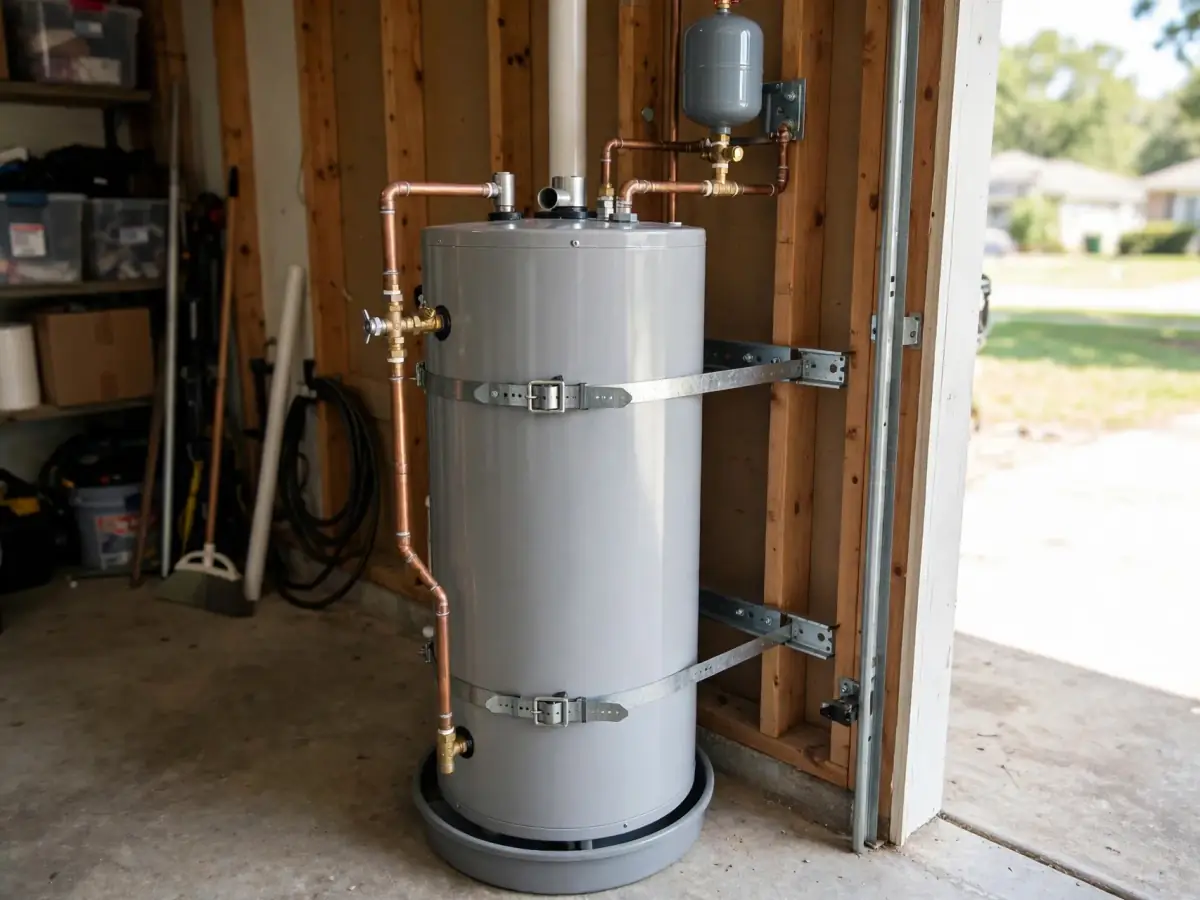
Key facts: Electric Water Heater Repair
- Most electric tanks have two elements: a failed upper element means no hot water, a failed lower element means hot water that runs out fast.
- A high-limit (reset) switch that keeps tripping means the water is overheating, usually from a stuck thermostat or shorted element.
- Heat pump water heaters use much less electricity than standard electric tanks for the same hot water [2].
- The U.S. Consumer Product Safety Commission recommends 120°F for most households [3].
How it works
How an electric water heater makes hot water
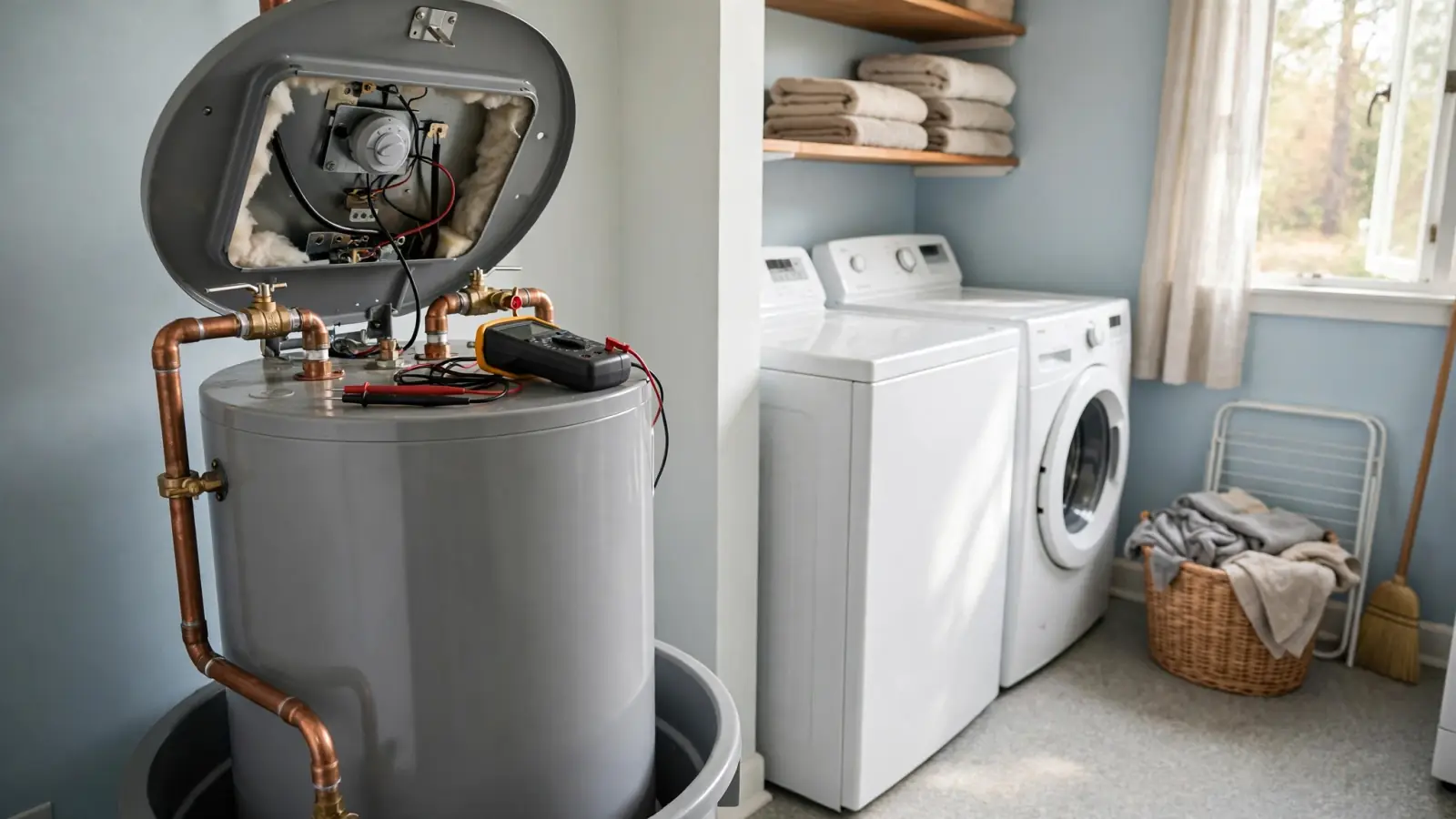
Most residential electric tanks have two heating elements, one near the top and one near the bottom, each with its own thermostat behind a small access panel. [1] The upper element heats first. Once the top of the tank is hot, the upper thermostat hands power to the lower element, which then does most of the work. Only one element runs at a time in a standard setup.
Above the upper thermostat sits a high-limit switch, often called the ECO or reset button. If the water ever gets dangerously hot, it cuts power to both elements and stays off until someone presses it. A heater that keeps tripping its reset is telling you something is wrong, usually a stuck thermostat or a shorted element.
This design explains the classic symptoms. If the upper element fails, you get no hot water at all, because the lower element never gets its turn. If the lower element fails, you get a small amount of hot water that runs out quickly, because only the top part of the tank is heating.
Signs
Signs your electric water heater needs a repair
No heat from the tank
A tripped breaker, a tripped high-limit switch or a failed upper element or thermostat.
Read moreShort bursts of hot water
Typically a failed lower element or lower thermostat, so only the top of the tank heats.
Reset button keeps tripping
The water overheated. A stuck thermostat or an element shorted to the tank are the usual causes, and both need fixing.
Breaker trips
An element shorted to ground, damaged wiring or a loose connection. Do not keep resetting it.
Water too hot
A thermostat stuck closed, or set far too high. Scalding is a real risk, especially for children and older adults.
Sizzling or hissing
Scale building up on the elements, which shortens their life and slows heating.
The repair
How an electric water heater is diagnosed
- 1
Power and breaker
Check the double-pole breaker, confirm 240 volts at the heater and look for heat damage on wiring.
- 2
Elements
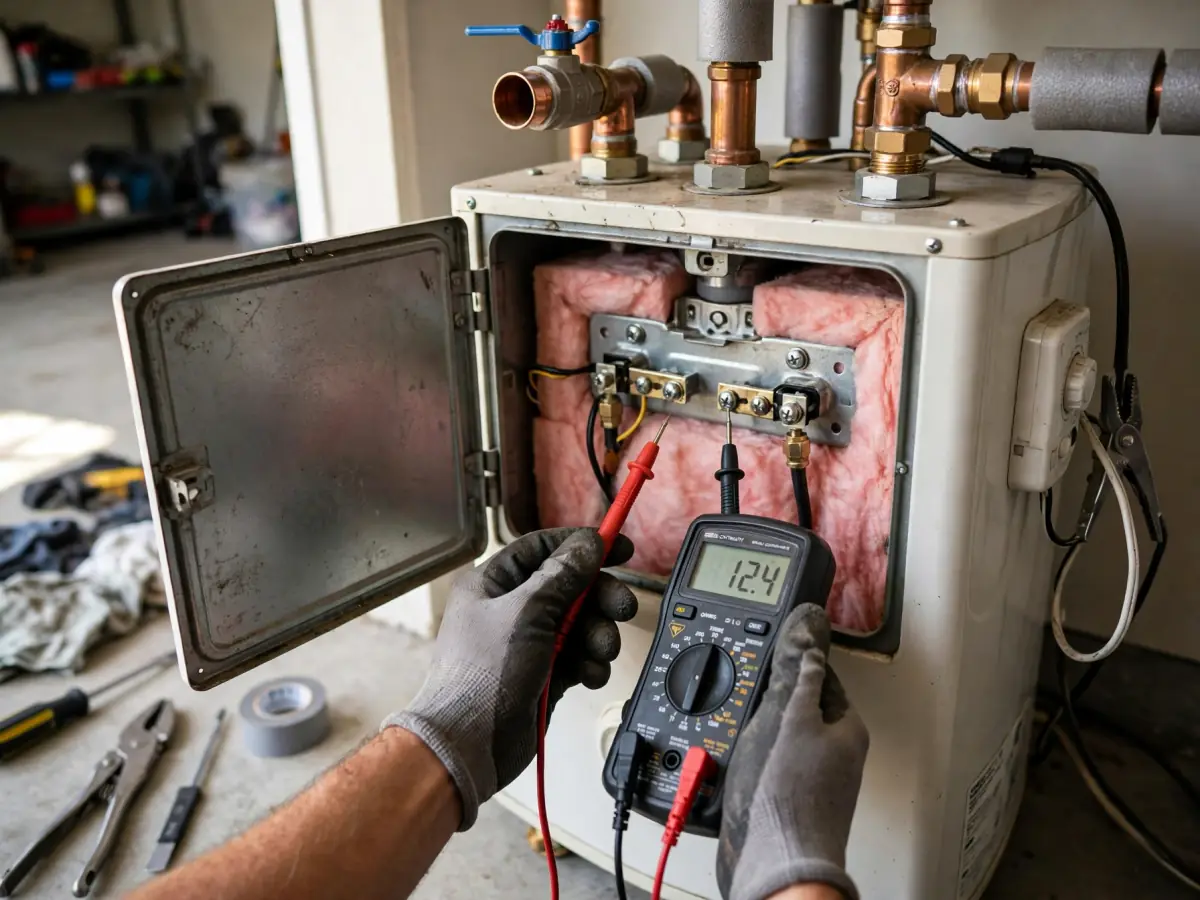
With the power off, each element is tested for continuity and for a short to the tank.
- 3
Thermostats
With the panels open and the power on under safe conditions, the plumber checks that each thermostat switches power as it should.
- 4
Replace and refill
Failed parts are replaced. The tank is completely refilled before power returns, because a dry element burns out in seconds.
Parts
Electric water heater parts that fail most
| Part | Typical symptom | Notes |
|---|---|---|
| Upper element | No hot water at all | Ask the plumber on the visit |
| Lower element | Hot water runs out quickly | Often fails sooner in hard water because sediment buries it |
| Thermostats | No heat, or overheating | Replaced in matching pairs on some models |
| High-limit (ECO) switch | Reset trips, no heat | Find out why it tripped before replacing it |
| Wiring and terminals | Burn marks, breaker trips | Loose terminals overheat; this is a fire risk to fix right away |
| Anode rod | Rusty or smelly hot water | Checking it every few years can extend the tank's life |
Do it yourself?
Safe checks on an electric heater
- Check the breakerReset it once if it is tripped. If it trips again, leave it off and call.
- Press the reset onceWith the breaker off, remove the upper access panel and press the red reset button. If it trips again within days, the heater needs diagnosis.
- Check the settingThermostats are usually set at the factory. The U.S. Consumer Product Safety Commission recommends 120°F for most households. [3]
- Leave it to a proTesting live 240-volt thermostats, replacing elements and repairing wiring should be done by a qualified professional.
Los Angeles
Electric heaters in Los Angeles buildings
In Los Angeles, electric tanks show up most in condo and apartment units, accessory dwelling units built behind houses, and homes where adding a gas line was not practical. Interior closets are common, which makes a drain pan with a proper drain line, and a quick response to any drip, more important than in a garage.
California's energy rules increasingly favor heat pump water heaters when an electric heater is replaced, and utilities have offered rebates for them at various times. [2] A heat pump unit is a different appliance with a compressor and fan, and it needs space and airflow, so it is worth talking through before an old electric tank fails completely.
Lifespan
When an electric heater is worth repairing
Diagnosis
How a plumber finds the fault on an electric tank
An electric water heater has no flame, no vent and no gas valve, so diagnosis is about electricity and heat. A standard residential electric tank has two heating elements, upper and lower, each controlled by its own thermostat. They do not run together. The upper element heats the top of the tank first, then the thermostat hands power to the lower element, which keeps the rest of the tank hot. [1]
That design explains the most common symptoms. If the upper element or thermostat fails, there is usually no hot water at all, because power never passes to the lower element. If the lower element fails, the top of the tank still heats, so you get a short burst of hot water before it turns lukewarm. A plumber tests each element for continuity and resistance, checks voltage at each thermostat with the power safely managed, and inspects the wiring and the high-limit reset switch.
Quick reference
Electric water heater symptoms and likely causes
| What you notice | Likely causes | What the plumber checks |
|---|---|---|
| No hot water at all | Tripped breaker or reset, failed upper element or thermostat | Breaker, high-limit reset, upper element and thermostat |
| A few minutes of hot water, then lukewarm | Failed lower element or lower thermostat | Lower element resistance and thermostat |
| Reset button keeps tripping | Thermostat stuck on, shorted element, loose wiring | Thermostat operation, element to ground, terminal connections |
| Water too hot | Thermostat set high or stuck closed | Thermostat settings and operation |
| Breaker trips when the heater runs | Element shorted to the tank, damaged wiring | Insulation test on each element and the supply wiring |
| Slow recovery after showers | One element out, sediment around the lower element | Both elements and sediment level |
| Burning smell or scorched panel | Loose or overheated terminals | Turn the breaker off; terminals and wiring inspected |
The reset button
What the red reset button is telling you
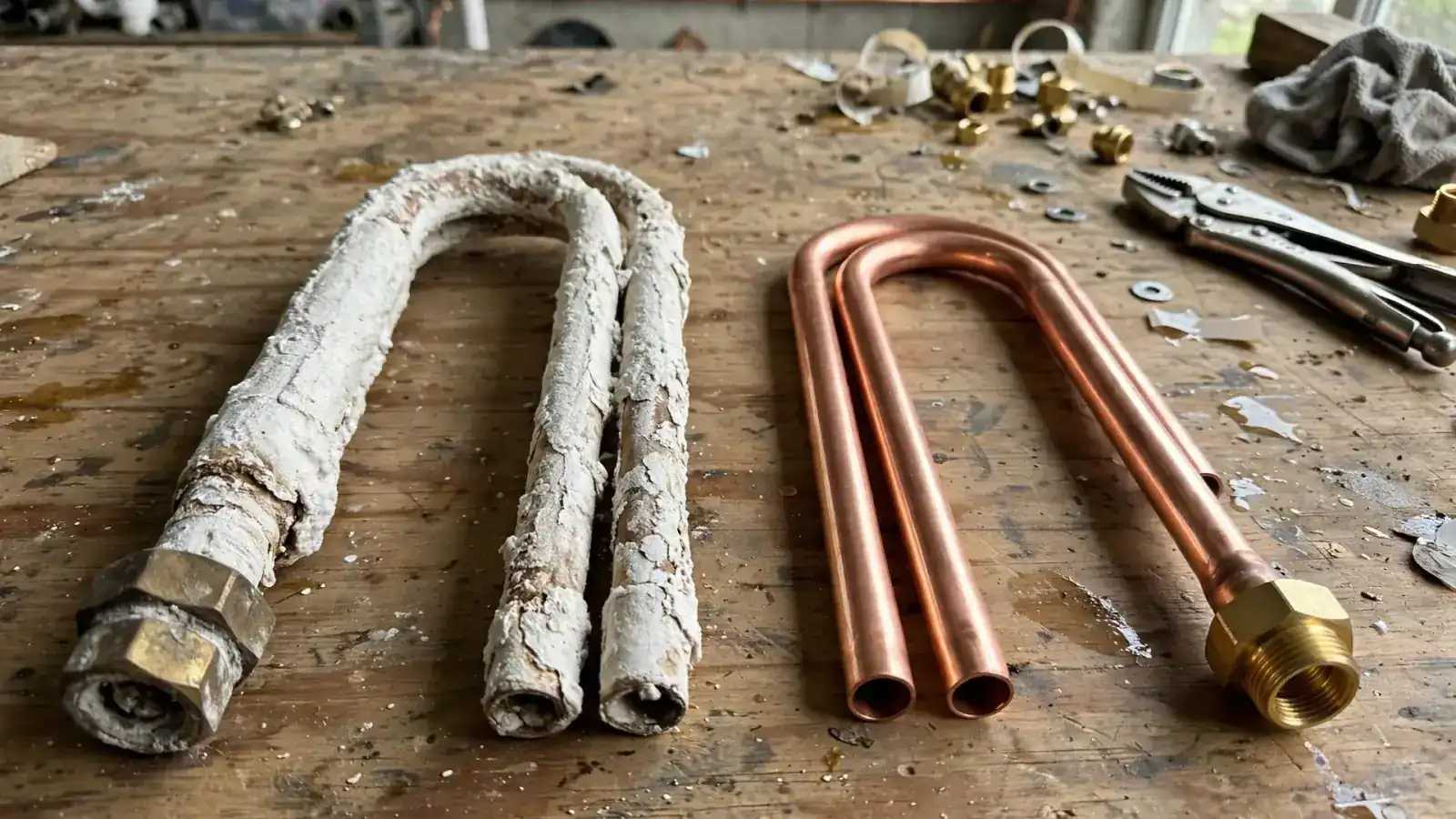
Behind the upper access panel, most electric heaters have a high-limit switch with a red reset button. It cuts power to both elements if the water gets dangerously hot. Pressing it once after a power event is reasonable. If it trips again, the heater is overheating for a reason, and pressing it repeatedly only puts off finding that reason.
The usual culprits are a thermostat that has stuck in the on position, an element that has shorted to the tank, or loose wiring that is overheating at the terminals. Each of these is a real safety problem. Turn the breaker off and leave it off until a professional has looked at the heater.
Before opening any access panel, the power must be off at the breaker and confirmed off with a tester. Electric water heaters run on 240 volts, which is far more dangerous than a household outlet.
Where they are
Electric water heaters in Los Angeles homes
Gas is the norm in most Los Angeles houses, so electric tanks tend to show up in particular places: condos and apartments without gas service to each unit, accessory dwelling units and guest houses, high-rise units, and homes where the owner has started moving away from gas. Many sit in small interior closets, which affects how a repair is done and how any leak is contained.
Closet installs should have a drain pan piped to a suitable drain, because a leak inside a condo can reach a neighbor's ceiling quickly. The relief valve discharge line needs to run to an approved location, not end inside the closet. If your electric heater is missing either of these, mention it during the visit; correcting them is usually straightforward while a plumber is already there.
Electric heaters also do not need a vent or combustion air, which is why they suit spaces where a gas heater would be difficult. That same flexibility is why many homeowners consider a heat pump water heater when an old electric tank fails. [2]
Maintenance
Keeping an electric water heater healthy
Electric tanks are simple, and a little upkeep prevents most element failures.
Flush the tank
Sediment collects around the lower element and makes it run hot and fail early. A yearly flush helps.
Read moreSet a sensible temperature
A setting around 120°F is enough for most households, saves energy and reduces scald risk. [3]
Check the anode rod
The anode protects the steel tank from corrosion. A worn rod can be replaced to extend the tank's life.
Read moreTest the relief valve
Lift the lever once a year to confirm it opens and closes. A valve that keeps dripping should be replaced.
Read moreNever run it dry
Turning power on to an empty tank burns out the elements in seconds. Refill completely before restoring power.
Keep the closet clear
Access panels and the drain valve need room. Stored items also hide early signs of a leak.
Capacity
Running out of hot water: element problem or the wrong size?
Not every complaint about short showers is a broken part. An electric tank recovers more slowly than a gas tank of the same size, because a single element at a time does the heating. A household that has grown, a new soaking tub, or a guest house sharing the same heater can simply ask more of the tank than it can deliver, even when both elements test perfectly.
A plumber separates the two by testing the elements and thermostats first, then looking at the capacity on the rating plate, the element wattage, and how the household uses hot water. If the parts are healthy, the options are practical ones: spreading out showers and laundry, a modestly higher thermostat setting with a mixing valve to keep taps safe, or a larger tank or heat pump unit at the next replacement. [1]
If only the top of the tank is hot, that points back to the lower element or its thermostat, which is a quick repair. Sediment that buries the lower element can produce the same symptom, which is one more reason a flush is part of a good electric heater service.
Safety
Electrical safety around an electric tank
Water and 240-volt power share a small space inside an electric water heater, so a few rules are worth repeating. Always switch the heater's breaker off before removing an access panel, and confirm the power is off with a tester rather than trusting the breaker label. Never restore power to a tank that has been drained until it is completely full and air has been bled from a hot tap; an element that runs in air burns out almost instantly.
Warning signs that call for switching the breaker off and leaving it off: a burning or hot-plastic smell from the access panels, discolored or melted wiring, a breaker that trips each time the heater calls for heat, or a tingle from any metal part of the heater or nearby piping. Any of these needs a professional before the heater runs again.
If water is leaking near the wiring or the access panels, turn off the breaker first, then close the cold-water valve above the heater. Wipe nothing and open nothing until the power is confirmed off.
Older tanks
Signs an older electric tank is wearing out
Electric tanks fail gradually, and a few signs say the tank itself, not just a part, is reaching the end. Rusty or brown water from the hot taps only, a metallic taste, moisture or rust around the bottom of the tank, and elements that fail again soon after being replaced all suggest corrosion or heavy sediment inside.
Age matters too. The manufacture date is usually coded into the serial number on the rating plate, and a plumber can read it for you. A tank well past its expected service life that shows any of these signs is a candidate for planned replacement before it leaks, especially in a closet above finished floors. [1]
If the tank is sound, a new element, thermostat and anode rod can give it years of further service.
Repair or replace
When to repair an electric tank and when to replace it
The exceptions are a tank that is visibly corroded, one that has been leaking from the body, or one that has needed repeated element replacements because of heavy sediment.
When replacement does make sense, you have more choices than a like-for-like electric tank. A heat pump water heater uses electricity to move heat from the surrounding air into the water and can use a fraction of the energy of a standard electric tank. [2] It needs more space, room for airflow, and a condensate drain, so not every closet suits one. A plumber can tell you on the visit whether your location works.
Ask for both quotes on paper: the repair and what it covers, and a replacement with the permit, drain pan, strapping and disposal included.
Before the visit
What to tell the plumber when you call
These details speed up diagnosis and help the plumber bring the right parts.
- The rating plateA photo of the label on the tank shows the brand, model, capacity, voltage and element wattage.
- The symptomNo hot water, a short burst then lukewarm, water too hot, or a breaker that trips. Say whether you pressed the reset button and what happened.
- Recent eventsA power outage, work on the electrical panel, a tank that was drained, or a recent element replacement all point the plumber in a direction.
- AccessCloset, garage, attic or utility room, and any building access rules in a condo or apartment.
Records
Keeping records for an electric heater
Write down the element wattage, voltage and model number from the rating plate, and keep a note of each repair with its date. If elements keep failing, that history helps a plumber spot a pattern such as heavy sediment, a wiring fault or a thermostat that is sticking.
FAQ
Electric water heater repair questions
Why does my electric water heater have hot water for only a few minutes?
The lower element or lower thermostat has usually failed, so only the top of the tank is being heated. A broken dip tube can also send cold water to the outlet. Testing the lower element is the first step.
Is it safe to keep pressing the reset button?
No. The high-limit switch trips when the water overheats. Pressing it once to see whether heat returns is reasonable; if it trips again, a thermostat or element fault is letting the water get too hot.
How long does an element replacement take?
Usually about an hour on site, most of it spent draining and refilling the tank. A tank with heavy sediment may take longer because the drain clogs.
Should I replace an old electric tank with a heat pump water heater?
A contractor can check whether your space and electrical service suit one.
Can a bad breaker cause no hot water?
Yes. A worn breaker can trip under normal load or fail to pass power on one leg, leaving the heater partly or fully dead. The plumber or an electrician can test it.
Why is my electric water heater making a hissing sound?
A sizzling or hissing sound often comes from sediment around the lower element or from water dripping onto a hot surface. Check for leaks first, then have the tank flushed and inspected.
Who repairs electric water heaters in Los Angeles?
A licensed plumber who works on water heaters. Call the number on this page and a plumber will ask about the symptoms and arrange a visit.
Can I replace a heating element myself?
Element replacement involves 240-volt wiring and draining the tank. Many manufacturers recommend a qualified professional, because a mistake can burn out the new element or cause a shock.
Why does my electric water heater trip the breaker?
A heating element shorted to the tank, damaged wiring, or a failing breaker are the usual causes. Leave the breaker off and have the heater tested before using it again.
How hot should an electric water heater be set?
Around 120°F suits most homes. It saves energy and lowers the risk of scalding, especially with young children or older adults in the house.
Why do my heating elements keep burning out?
Common causes are heavy sediment around the lower element, power restored to a tank that was not full, the wrong replacement element, or a wiring fault. A plumber looks for the pattern.
Does an electric water heater need a vent?
No. Electric tanks burn no fuel, so they need no vent or combustion air, which is why they suit closets, condos and ADUs.
Can an electric heater run on a 120-volt outlet?
Most whole-house electric tanks need a dedicated 240-volt circuit. Small point-of-use units may run on 120 volts.