Key facts: Expansion Tank Installation
- Water expands as it heats; in a closed plumbing system that expansion raises pressure every time the heater runs.
- A plumbing system becomes closed when a pressure-reducing valve, check valve or backflow preventer stops water flowing back to the street.
- An expansion tank has an air cushion behind a rubber diaphragm that absorbs the extra water and keeps pressure steady.
- The tank must be sized for the heater and pre-charged to the household's water pressure to work properly.
The problem
Why heated water needs somewhere to go
Water expands when it is heated. A typical tank water heater warming a full tank of cold water creates a noticeable amount of extra volume, and because water barely compresses, that extra volume has to go somewhere. In an open plumbing system, it simply pushes back into the city water main. Nothing in the house notices.
Many homes are no longer open systems. A pressure-reducing valve at the main line, a check valve at the meter or a backflow prevention device stops water from flowing backwards into the street. Those devices exist for good reasons, protecting fixtures from high street pressure and the public supply from contamination, but they also trap the house's water. Every time the heater runs, the expanding water raises the pressure throughout the plumbing.
Those spikes are hard on everything. The relief valve on the heater may open and drip, toilet fill valves may hiss, faucet cartridges and appliance hoses wear faster, and the tank itself flexes with each cycle. A thermal expansion tank gives the extra water a place to go, keeping pressure steady and protecting the whole system.
Warning signs
Signs your home needs an expansion tank
Relief valve drips after heating
Water released from the heater's discharge pipe after a heating cycle is the classic sign of thermal expansion in a closed system.
Pressure-reducing valve installed
Most homes with a pressure-reducing valve at the main line are closed systems and normally need expansion control.
Toilets run briefly on their own
Pressure spikes can force water past fill valves, making toilets hiss or refill without being flushed.
Faucets drip more over time
Repeated pressure spikes wear cartridges and washers faster than normal.
Banging when taps close
Water hammer is a separate issue, but it often appears alongside high or spiking pressure.
New heater, no tank
If a heater was replaced recently and no expansion tank was added in a closed system, an inspector would usually flag it.
How it works
How an expansion tank works
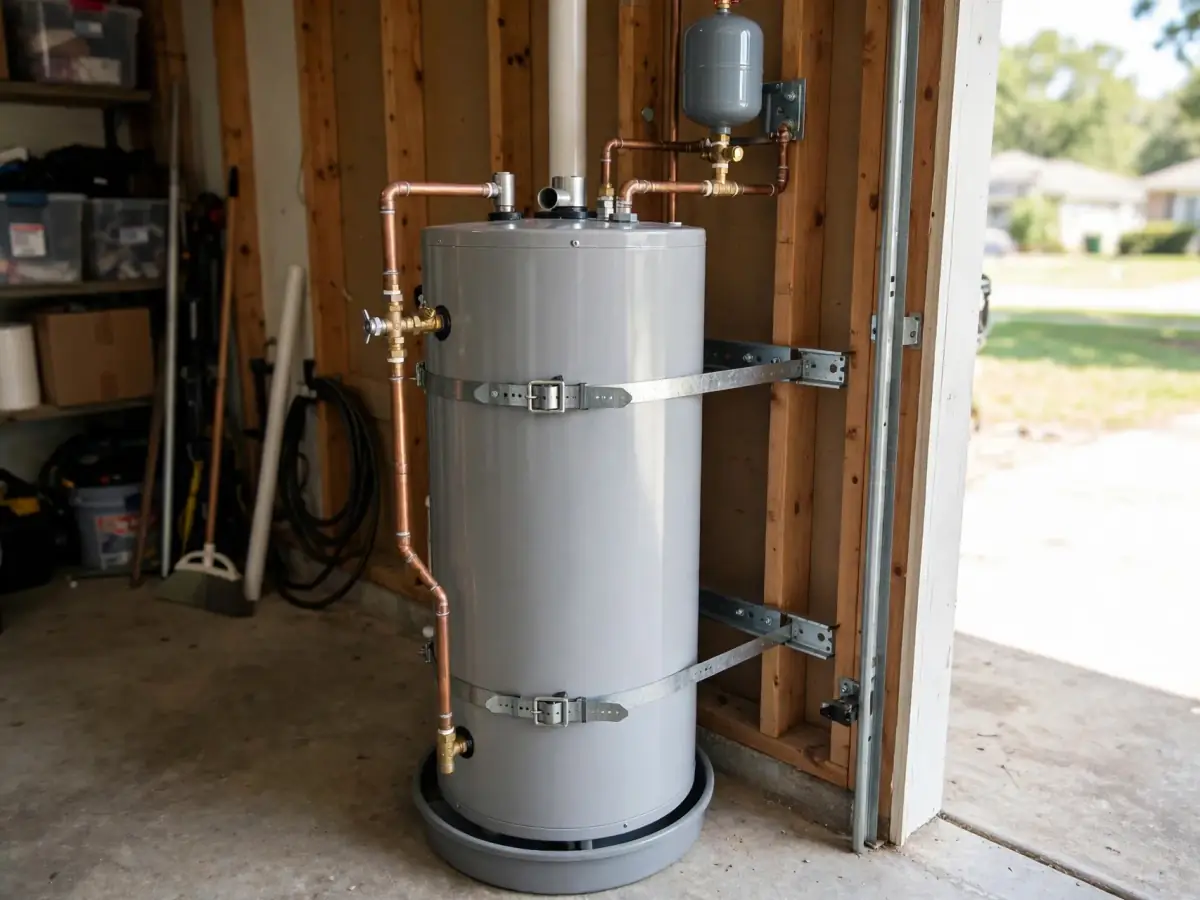
A thermal expansion tank looks like a small steel tank, often about the size of a basketball or a little larger, mounted on the cold water supply near the water heater. Inside, a rubber diaphragm or bladder divides it into two chambers. One side connects to the house plumbing and fills with water. The other side holds a cushion of air, pre-charged to a set pressure through a valve like the one on a car tire.
When the heater warms the water and it expands, the extra water pushes into the tank and compresses the air cushion. Pressure in the house rises only slightly instead of spiking. When hot water is used and the system cools, the air cushion pushes the water back out into the plumbing. The diaphragm keeps the air and water separate, so the cushion does not dissolve into the water over time.
For this to work, the air cushion must be set to roughly match the household's static water pressure. If the pre-charge is far too low, the tank fills with water before the heater even runs and has no room left for expansion. If it is far too high, expansion pressure has to build up before the tank accepts any water at all. Setting the pre-charge correctly at installation is as important as the tank itself.
Testing
How a plumber confirms thermal expansion
- 1
Find the system type
Locate any pressure-reducing valve, check valve or backflow device at the main line or meter that would make the system closed.
- 2
Measure static pressure
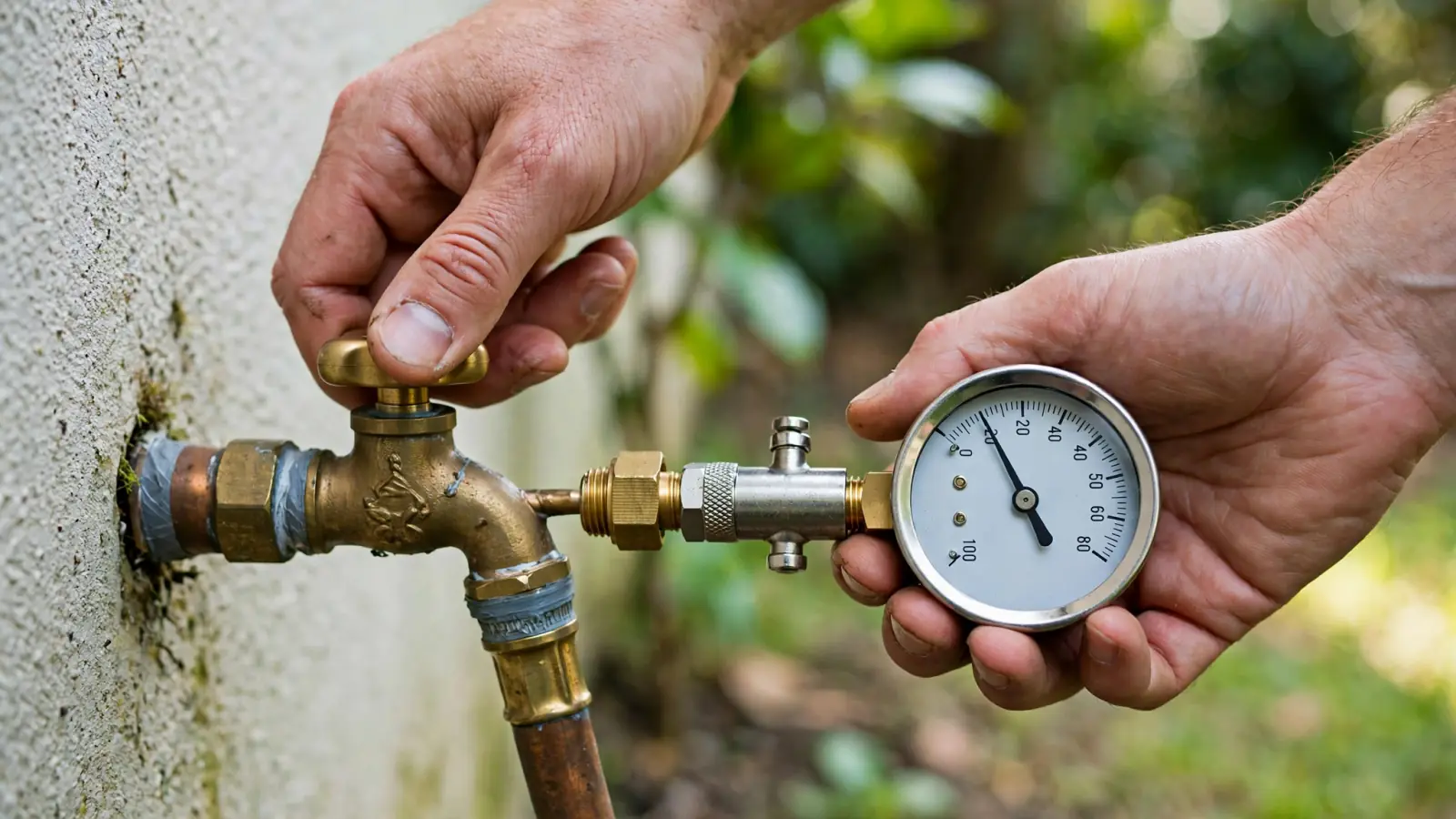
A gauge on a hose bib reads the pressure with no water flowing and confirms the pressure-reducing valve is working.
- 3
Record the peak
A tell-tale gauge left in place during a heating cycle records how high pressure climbs as the water expands.
- 4
Check an existing tank
If a tank is already installed, its air side is checked for pre-charge and its water side for signs of a failed diaphragm.
Sizing
How expansion tanks are sized
Manufacturers publish sizing charts. These are the factors that decide the size.
| Factor | Why it matters |
|---|---|
| Water heater capacity | A larger tank of water produces more expansion volume when heated |
| Supply pressure | Higher static pressure leaves less room in a given tank, often calling for a larger one |
| Heater temperature setting | Hotter settings mean more expansion from cold to set temperature |
| Maximum allowed pressure | The tank must hold pressure safely below the relief valve setting |
| Number of heaters | Multiple heaters or a large storage system may need a larger tank or more than one |
The job
How an expansion tank is installed
- 1
Choose and pre-charge
The tank is sized for the heater and its air side is set to match the measured household pressure before installation.
- 2
Shut off and relieve
The water supply is shut off and pressure relieved so the cold line can be cut or a fitting added.
- 3
Mount and support
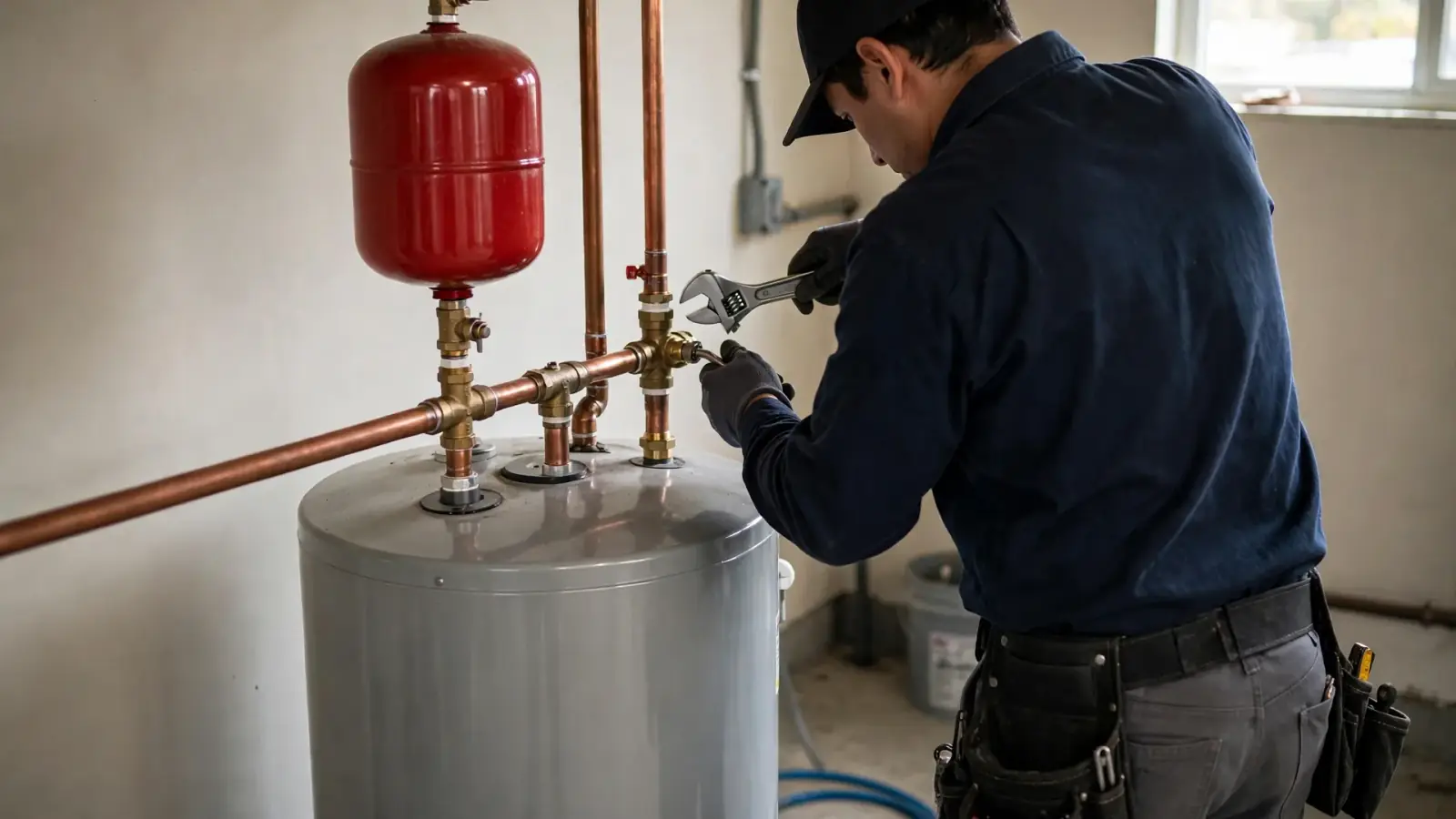
The tank is connected to the cold supply, usually with a tee, and supported with a bracket or strap because a full tank is heavy.
- 4
Restore and verify
Water is restored, connections checked for leaks, and pressure monitored through a heating cycle to confirm spikes are gone.
Placement
Where the tank goes, and why support matters
- On the cold supplyThe tank is installed on the cold water line between the main shut-off and the heater, usually close to the heater.
- OrientationMany manufacturers allow vertical or horizontal mounting; follow the tank's instructions, since some orientations reduce diaphragm life.
- Supported, not hangingA tank full of water is heavy. Hanging it from copper pipe alone can stress the joints; a strap or bracket carries the weight.
- Accessible air valveThe pre-charge valve should be reachable so the air pressure can be checked during maintenance.
- Seismic considerationsIn earthquake country, the tank's support should hold it securely along with the heater's own straps.
Failure
How expansion tanks fail
Expansion tanks do not last forever. The most common failure is a ruptured or leaking diaphragm. Water gets into the air side, the cushion disappears, and the tank simply fills with water and stops absorbing anything. From the outside, nothing looks wrong, but the relief valve starts dripping again after heating cycles.
A plumber checks this by tapping the tank: the air side should sound hollow and the water side solid. Pressing the air valve should release air, not water. A tank that is heavy and full all the way through, or that spits water from the air valve, has failed. Slow loss of pre-charge is another failure mode, which is why the air pressure should be checked during routine maintenance and topped up if it has dropped.
Corrosion on the outside of the tank, especially at the bottom connection, is a third issue in damp locations. A rusted tank should be replaced before it leaks.
Which fix
Expansion tank, pressure-reducing valve or water hammer arrestor?
Three devices solve three different pressure problems. Getting the right one depends on what the gauge shows.
| Device | Problem it solves | Symptom it fixes |
|---|---|---|
| Thermal expansion tank | Pressure rising as heated water expands in a closed system | Relief valve dripping after heating cycles |
| Pressure-reducing valve | Street pressure too high for the house | High pressure all the time, leaking fixtures, noisy pipes |
| Water hammer arrestor | Shock wave when a fast-closing valve stops flowing water | Loud bang when a washer or faucet shuts off |
| Relief valve replacement | A worn valve that no longer seals | Constant weep even at normal pressure |
Water hammer
Expansion or water hammer? Telling them apart
People often describe both problems the same way: something wrong with the water pressure. They are different. Thermal expansion is slow and quiet: pressure climbs gradually as the heater runs and falls again when hot water is used. Its signature is a relief valve that drips at the end of a heating cycle. Water hammer is instant and loud: a bang or knock when a valve snaps shut, most often a washing machine, dishwasher or a single-lever faucet.
A recording pressure gauge separates them easily. Expansion shows as a gentle rise over many minutes; hammer shows as sharp spikes when appliances shut off. Homes with high static pressure often have both, which is why a plumber may recommend checking the pressure-reducing valve, adding an expansion tank and fitting arrestors at the worst appliances together.
Do it yourself?
What homeowners can check
- Look for a pressure-reducing valveIt is usually a bell-shaped brass valve near the main shut-off. If you have one, you probably have a closed system.
- Tap testIf you already have an expansion tank, the top half should sound hollow. A tank that sounds full all the way may have failed.
- Watch the relief pipeWater from the heater's discharge pipe after heating cycles suggests thermal expansion.
- Leave installation to a proCutting into supply lines, setting pre-charge and supporting the tank properly are plumbing work best done by a licensed professional.
The visit
What to expect at the appointment
A typical expansion tank visit begins with pressure measurements: static pressure at a hose bib, then a recording gauge left in place while the heater runs. If expansion is confirmed, the plumber explains the tank size needed and the pre-charge setting, then installs it on the cold line with proper support.
Afterwards, a second pressure check during a heating cycle should show a much smaller rise than before, and the relief valve should stay dry. If the house pressure itself was high, you may also be advised to adjust or replace the pressure-reducing valve so the expansion tank and relief valve are not fighting excessive pressure all the time.
Los Angeles
Expansion tanks in Los Angeles homes
Pressure-reducing valves are common in Los Angeles, especially in hillside neighborhoods and homes at lower elevations where street pressure runs high. Combined with backflow and check devices, that makes closed plumbing systems the norm in many houses, and expansion control a routine part of water heater work here.
When a water heater is replaced in the City of Los Angeles, the permit inspection looks at the installation as a whole, including the relief valve, the discharge and expansion control where the system is closed, alongside the seismic strapping California requires for every water heater [1][2]. Adding a missing tank during a replacement is far easier than going back later.
Maintenance
Looking after an expansion tank
- Check the air pre-charge during routine water heater maintenance and top it up to match house pressure if it has dropped.
- Tap-test the tank each year; a tank that sounds full has likely lost its air cushion.
- Look for rust at the bottom connection and replace a corroding tank before it leaks.
- Confirm the tank's support strap or bracket is still secure, especially after an earthquake.
- Re-check the pre-charge if the pressure-reducing valve is replaced or adjusted.
Safety
Why pressure control is a safety issue
An expansion tank is often presented as a convenience, but it plays a safety role. In a closed system without expansion control, the heater's relief valve becomes the only thing limiting pressure, and it was designed as an emergency device rather than something that should open every day. Valves that open repeatedly wear out and can eventually stick, which is the worst possible outcome for a pressurized tank of hot water.
Keeping pressure steady with a correctly sized and charged expansion tank lets the relief valve go back to being a last line of defense, ready for a genuine emergency rather than worn out by routine use.
Benefits
What an expansion tank protects
The most visible benefit is a relief valve that stays dry. Less visible, but just as valuable, is what it protects elsewhere. Steady pressure means toilet fill valves, faucet cartridges, washing machine and dishwasher hoses, ice maker lines and the flexible water connectors at the top of the heater all see less stress. Many unexplained plumbing leaks in closed systems trace back to repeated pressure spikes.
The water heater benefits too. A tank that is not flexed by pressure spikes on every cycle is under less strain at its welds and fittings, which supports a longer working life.
With a new heater
Adding expansion control during a heater replacement
The best time to add an expansion tank is when the water heater is replaced. The water is already off, the cold line is already being reworked, and the permit inspection will look at the whole installation anyway.
Ask the installer to confirm the system type, measure the house pressure and include the tank, its support and the pre-charge setting in the written quote. If the existing pressure-reducing valve is old or the pressure reads high, it is also a sensible moment to service or replace it, so the new heater starts life with the whole system in good shape.
A replacement is also a good time to review the discharge pipe from the relief valve, the seismic straps and the water connectors. Together with expansion control, these details decide how well the new heater is protected for the rest of its life.
Checking
Checking an existing expansion tank
An expansion tank that has been in place for years may no longer be doing its job. Inside, a rubber diaphragm separates water from a cushion of air. If the diaphragm fails, the tank fills with water and the system loses its protection, even though the tank still looks fine from outside.
A plumber checks the tank by tapping it, the top should sound hollow, and by testing the air charge at the valve on the end with the water pressure relieved. A tank that is waterlogged or will not hold its charge should be replaced, and a dripping relief valve often points to one.
FAQ
Expansion tank questions
Do I need an expansion tank for my water heater?
If your plumbing is a closed system, because of a pressure-reducing valve, check valve or backflow device, you normally do. Local code and the heater manufacturer usually require it in that situation.
How do I know if my expansion tank is bad?
Tap it: the air side should sound hollow. If it sounds full, or water comes out of the air valve, the diaphragm has likely failed and the tank needs replacing.
What pressure should an expansion tank be set to?
The air pre-charge is usually set to match the household's static water pressure, measured at a hose bib. The tank's instructions give the exact procedure.
How long do expansion tanks last?
Many last for years, but diaphragms eventually fail. Checking the pre-charge and tapping the tank during maintenance catches failure early.
Can an expansion tank be installed horizontally?
Some can. Follow the manufacturer's instructions, and make sure the tank is properly supported rather than hanging from the pipe.
Does a tankless water heater need an expansion tank?
Tankless units hold very little water, so thermal expansion is much smaller. Requirements vary, so ask the installer and check local code.
Will an expansion tank lower my water pressure?
No. It does not reduce normal pressure; it absorbs spikes caused by heating. Lowering household pressure is the job of a pressure-reducing valve.
Can I install an expansion tank myself?
Installing an expansion tank means cutting into the water supply, setting the air pre-charge and supporting a heavy tank. A licensed plumber usually does it, often as part of a permitted heater replacement.
Why does my relief valve still drip after installing an expansion tank?
The tank may be undersized, its pre-charge may not match the house pressure, its diaphragm may have failed, or the relief valve may be worn from months of discharging and need replacing too.
Is an expansion tank required by code in Los Angeles?
Plumbing code generally requires a means of controlling thermal expansion where the water system is closed. Your installer and the permit inspection confirm what applies to your home.
Can one expansion tank serve two water heaters?
Sometimes, if it is sized for the combined volume and installed on a shared cold supply. Larger systems may need a bigger tank or one per heater.
What does an expansion tank look like?
Usually a small round steel tank, often blue, white or grey, mounted on the cold water pipe near the water heater, with a tire-style air valve on one end.
How long does an expansion tank installation take?
On an accessible heater, usually an hour or two including pressure testing. It takes longer if the pressure-reducing valve also needs work or the heater is in a tight space.
How do I know if my expansion tank has failed?
A failed tank often sounds solid rather than hollow at the top, and the relief valve may drip after the heater runs. A plumber can test the air charge to confirm.
Where is an expansion tank installed?
Usually on the cold-water line near the heater, supported so its weight does not hang on the pipe.