Key facts: Anode Rod Replacement
- An anode rod is a sacrificial metal rod that corrodes in place of the steel tank; once it is used up, the tank starts to rust.
- Checking the anode every few years, and replacing it before it is gone, can extend the life of a tank water heater [1].
- A rotten-egg smell in hot water only usually comes from bacteria reacting with a magnesium anode, and a different anode type fixes it.
- Never remove the anode without replacing it; the tank would corrode quickly and the warranty may be affected.
How it works
What an anode rod does
A water heater tank is made of steel lined on the inside with a thin layer of glass, often called glass lining or porcelain enamel. [1] The lining protects most of the steel, but no lining is perfect. Tiny gaps exist around fittings, welds and the openings for the dip tube and outlet, and water is always in contact with the metal there.
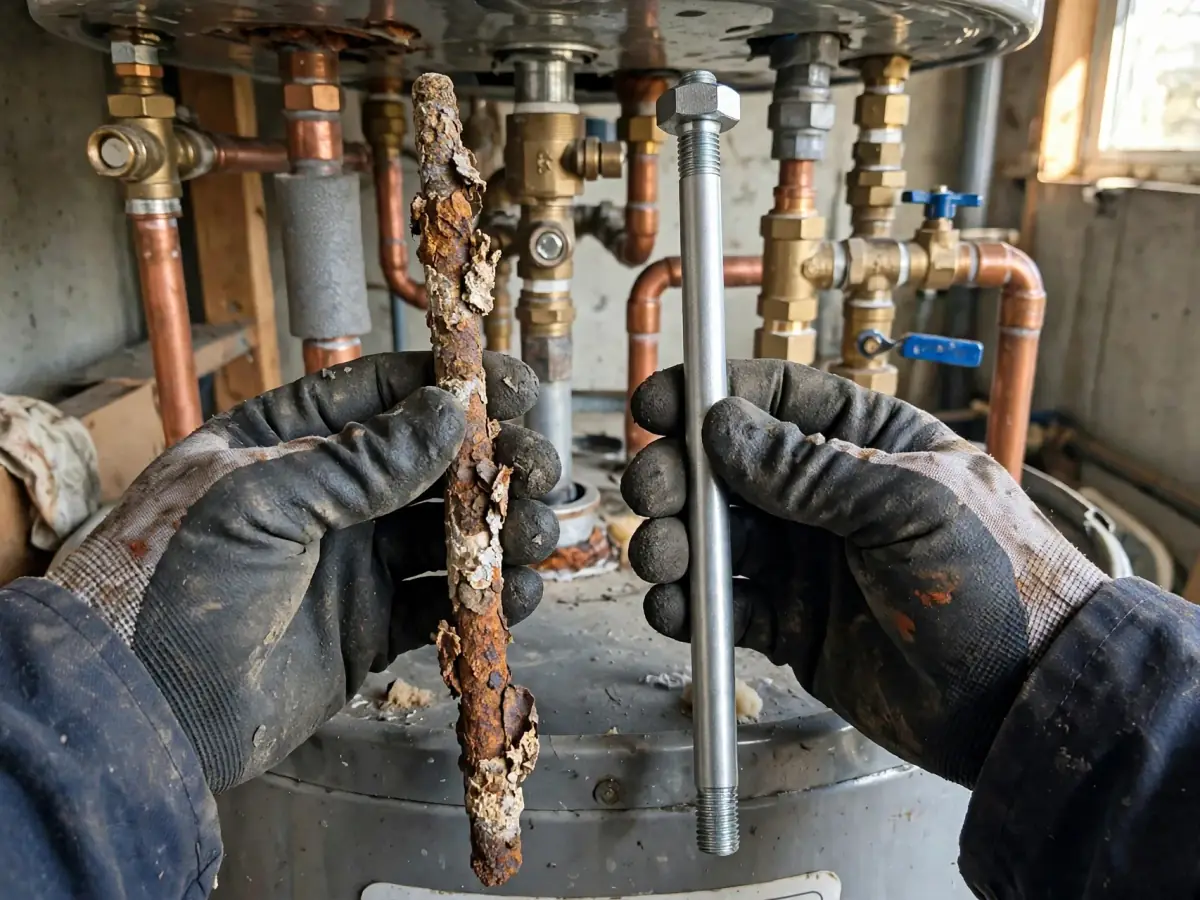
The anode rod solves that problem with chemistry. It is a long rod, usually magnesium, aluminum or an aluminum-zinc alloy, built around a steel core wire and screwed into the top of the tank. Because these metals are more electrochemically active than steel, corrosion attacks the rod first. The rod slowly dissolves and, in doing so, protects any exposed steel in the tank. That is why it is called a sacrificial anode.
The protection lasts only as long as there is anode metal left. Once the rod is reduced to its bare core wire, corrosion moves to the tank itself. Rust forms at the weak points, the lining fails further, and eventually the tank leaks.
Warning signs
Signs your anode rod needs attention
Rotten-egg smell in hot water
Sulfate-reducing bacteria react with a magnesium anode and produce hydrogen sulfide gas. The cold water does not smell because it never touches the anode.
Rusty hot water
Brown or orange water from hot taps only can mean the anode is spent and the tank has started to corrode.
Tank is several years old
Even without symptoms, rods in many homes are well worn after a few years, especially with harder or softened water.
Gritty particles in aerators
Flakes of anode material and sediment can clog faucet aerators and showerheads.
Rumbling from anode residue
Anode residue adds to the sediment layer at the bottom of the tank, which pops and rumbles when heated.
Never been checked
If nobody has looked at the anode since the heater was installed, it is worth an inspection before problems appear.
Why they wear out
What uses up an anode rod
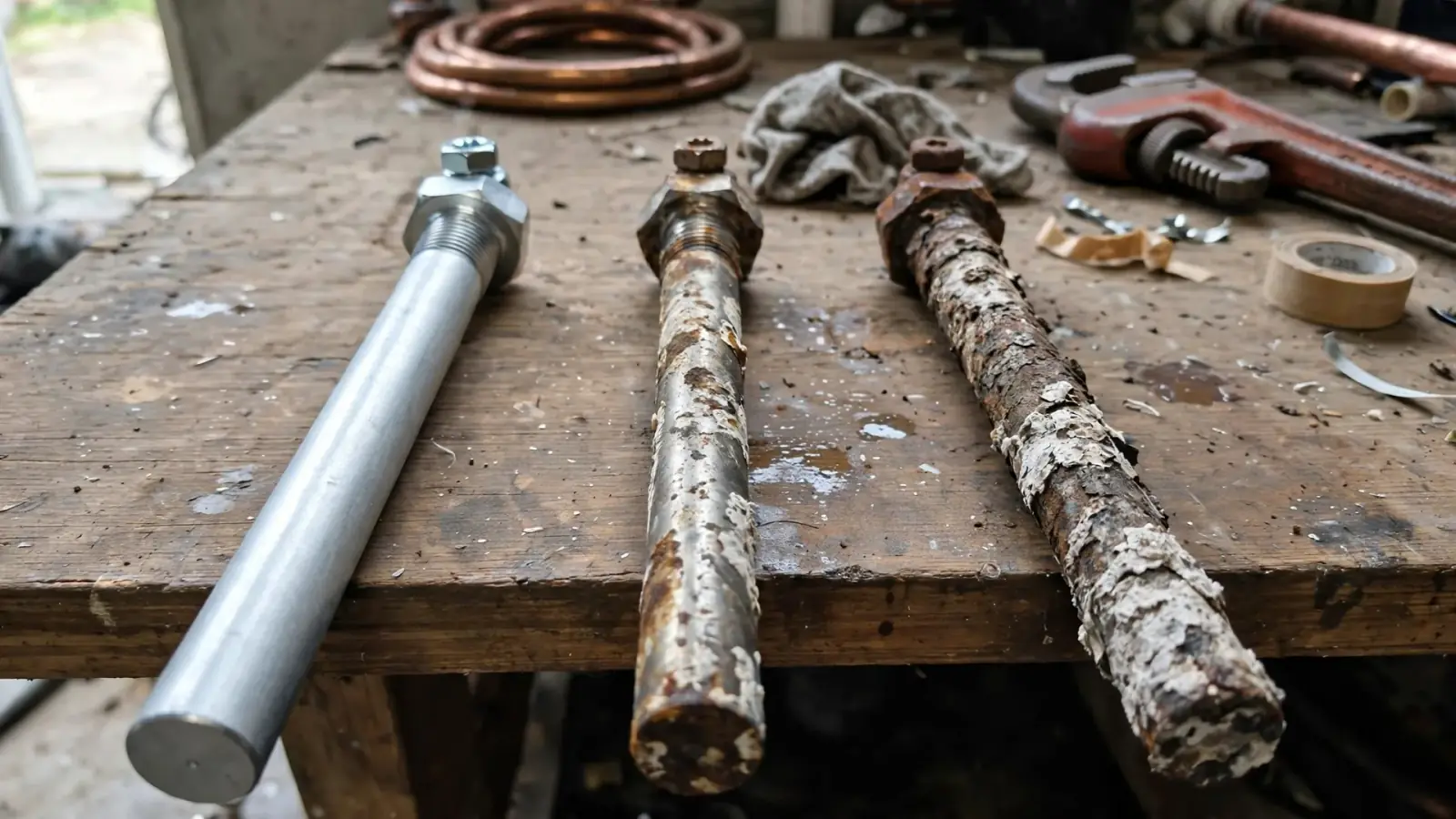
Anode rods wear at very different rates from house to house. The biggest factors are water chemistry, temperature and how much hot water the household uses. Harder water with more dissolved minerals, higher temperature settings and heavy use all speed up consumption. So does softened water: water softeners replace hardness minerals with sodium, which makes the water more conductive and can dissolve a rod much faster.
Electrical factors matter too. Dissimilar metals connected directly at the tank, poorly grounded plumbing and certain repairs can change how quickly the anode corrodes. A plumber who sees an unusually fast-dissolving rod will look at the connections, the use of dielectric fittings and whether a softener has been added.
Because of all these variables, there is no single replacement schedule that fits every home. Manufacturers often suggest inspecting the rod every few years, and many plumbers recommend a first check a few years after installation to learn how fast it wears in that particular house. That first inspection sets a sensible interval for the rest of the heater's life.
Anode types
Magnesium, aluminum-zinc and powered anodes
The right rod depends on your water and whether odor is a problem.
| Type | Strengths | Trade-offs | Good fit when |
|---|---|---|---|
| Magnesium | Strong protection; very active | Wears faster in some water and can feed sulfur odor | Average water with no smell problem |
| Aluminum-zinc | Zinc helps suppress the sulfur smell; longer life in harder water | Slightly less active than magnesium | Rotten-egg odor or harder water |
| Aluminum | Durable in hard water | Less common now; zinc versions usually preferred | Hard water where odor is not an issue |
| Powered (impressed current) | Does not dissolve; uses a small electric current | Needs a power outlet and correct installation | Persistent odor, softened water or very fast rod wear |
| Flexible (segmented) | Fits where ceiling height is too low to insert a straight rod | Same metals and trade-offs as above | Closets, attics and low-clearance installations |
Use a rod approved by the heater manufacturer where the warranty requires it.
Inspection
How an anode rod is checked
- 1
Shut off and relieve pressure
Power or gas is turned off, the cold supply closed, and pressure relieved through a hot tap.
- 2
Drain a few gallons
Enough water is drained to lower the level below the anode fitting so it can be opened without spilling.
- 3
Remove and inspect
The rod is unscrewed with a socket and breaker bar, then examined for remaining metal and exposed core wire.
- 4
Decide and reinstall
A healthy rod goes back in with fresh thread sealant; a worn rod is replaced with the right type and length.
The job
How an anode rod is replaced
The work is mechanical, but the factory-installed rod is often extremely tight, which is why the right tools matter.
- 1
Find the anode
It sits under a cap on top of the tank or is combined with the hot outlet nipple on some models.
- 2
Break it loose
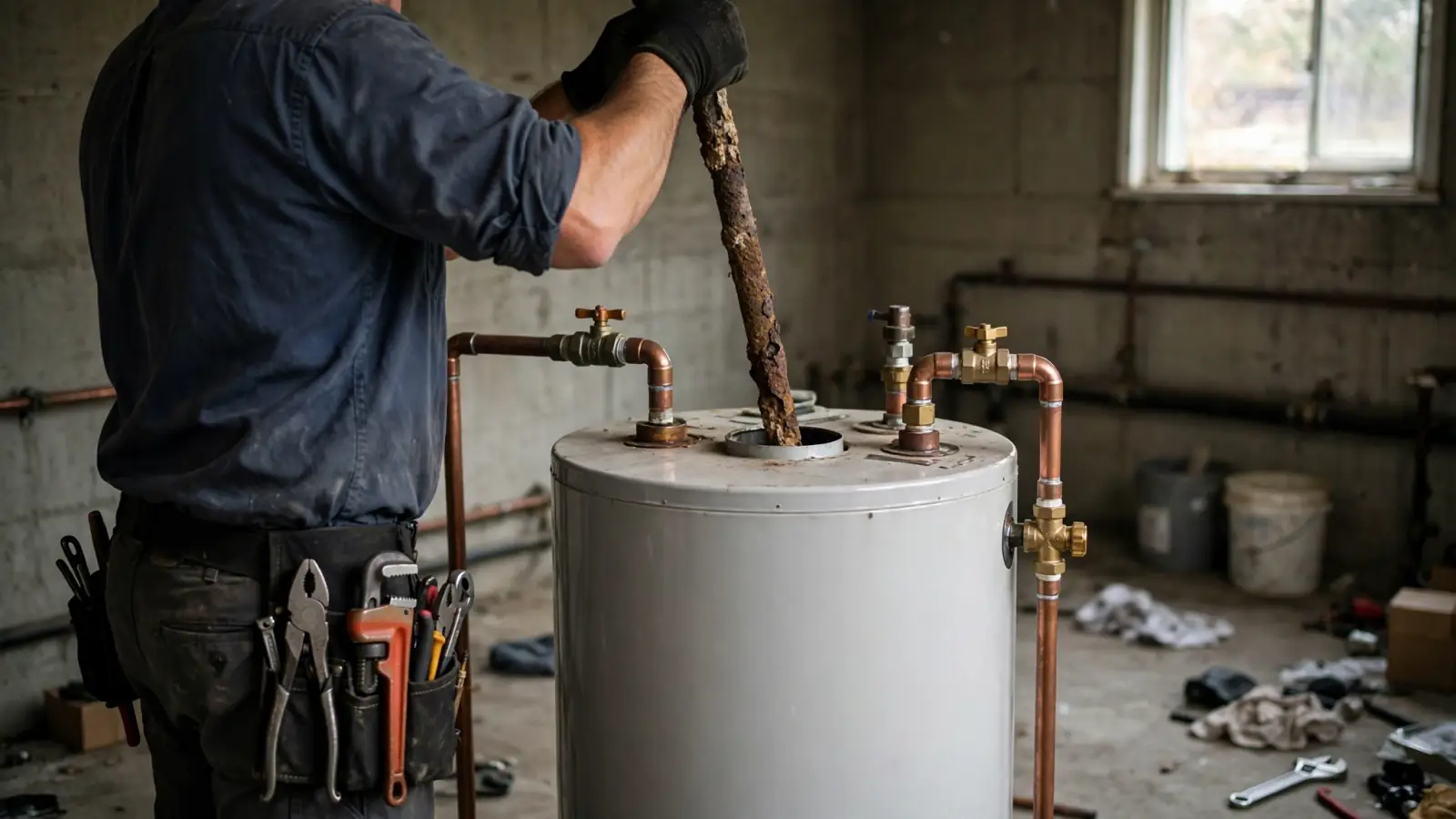
A long breaker bar and socket, with the tank braced against turning, frees the old rod without damaging the tank or its connections.
- 3
Fit the new rod
The new rod, sized to the tank, is installed with sealant. Flexible rods are used where overhead clearance is limited.
- 4
Refill and check
The tank is refilled, air purged at a hot tap, the fitting checked for leaks and power or gas restored.
Smell
Fixing the rotten-egg smell
A sulfur smell that appears only in hot water is one of the most common reasons people discover their anode rod. Harmless sulfate-reducing bacteria in the water supply react with the magnesium in the rod and produce hydrogen sulfide gas, which is noticeable at very low levels. It is unpleasant but usually not a sign that the tank is failing.
The standard fix has two parts. First, the magnesium rod is replaced with an aluminum-zinc rod or a powered anode, which removes the reaction that feeds the odor. Second, the tank may be disinfected following the manufacturer's instructions to clear the bacteria already inside. Some guides suggest raising the tank temperature for a period to kill bacteria; that can help, but it increases scalding risk and should only be done carefully and with everyone in the house warned.
Do not simply remove the anode to stop the smell. The odor will go, but so will the tank's corrosion protection, and the heater can fail years early. If cold water smells too, the source is the water supply or the plumbing, not the heater, and water testing is the next step [3].
Sizing
Choosing the right length and fitting
Anode rods come in different lengths and diameters to suit tank sizes, and some heaters use two rods: one in a dedicated port and a second built into the hot water outlet fitting, sometimes called a combination anode. Replacing only one of a pair leaves part of the tank less protected, so a careful plumber checks the heater's specifications before choosing parts.
The thread size and the length of the hex head also vary, and the rod should reach most of the way down the tank without touching the bottom. Where overhead clearance is less than the rod's length, a flexible rod made of linked segments is used. It bends as it goes in and then hangs straight inside the tank, giving the same protection as a solid rod.
Rod or tank?
Is it the rod or the tank?
| What you see | What it suggests | Best next step |
|---|---|---|
| Sulfur smell, hot water only, no rust | Bacteria reacting with a magnesium rod | Aluminum-zinc or powered anode plus tank disinfection |
| Rod worn but tank clean and dry | Protection running low, tank still sound | Replace the rod now; good value |
| Rusty hot water, rod down to bare wire | Tank has started corroding | Replace the rod and plan for the tank's remaining life |
| Water seeping from the tank shell | Lining and steel have failed | Shut off water; replace the heater |
| Rod disappearing within a year or two | Softened water or electrical factors | Check softener, fittings and grounding; consider a powered anode |
Safety
Safety when working on the top of the tank
Hot water heaters are under the full pressure of the household supply, and the water inside can be scalding. Before the anode fitting is loosened, the heater must be turned off, the cold supply closed and pressure relieved through a hot tap, and the water ideally allowed to cool. Opening a pressurized fitting can spray hot water.
The force needed to break a stuck rod loose can also twist the tank, damaging the water connections, the vent or the gas line. Bracing the tank and using the right length of breaker bar, rather than impact tools that can crack the fitting, protects the installation.
Do it yourself?
What you can do, and what to leave to a pro
- Note the symptomsCompare hot and cold water for smell and color in white cups; that tells the plumber whether the heater is involved.
- Find the install dateThe age encoded on the rating plate helps decide whether an inspection or a replacement makes sense.
- Avoid forcing the rodWithout a breaker bar and a way to brace the tank, a stuck rod can twist the tank and break plumbing connections.
- Leave disinfection to instructionsTank treatment should follow the manufacturer's guidance, and changes to temperature settings carry scalding risk.
The visit
What to expect at an anode appointment
An anode visit is usually short and tidy. The plumber shuts off the heater, drains a little water, removes the rod and shows it to you so you can see how much protection is left. If the rod is still in good condition, it goes back in and you have a clear idea of when to check it again. If it is spent, a new rod of the right type and length is installed.
Because the tank is already partly drained, the visit is a good time to flush sediment from the bottom of the tank and to look at the relief valve, the water connections and the strapping. The rod itself often says a lot about the tank's health: a rod that has completely disappeared on a heater that is already old suggests the tank has been corroding for some time, and a replacement plan may be wise.
Los Angeles
Anode rods and Los Angeles water
Los Angeles draws its water from several sources, blended differently across neighborhoods and over time, so hardness and mineral content vary from one part of the city to another. That variation is a big reason rods last much longer in some homes than in others, and why an inspection is more useful than any generic schedule. LADWP publishes water quality information for its service area [2].
Water softeners and whole-house filtration are increasingly common in Los Angeles homes. Softened water reduces scale but tends to consume anode rods faster, so households with a softener benefit from more frequent checks or a powered anode. Many homes also have heaters in closets or under low ceilings, where a flexible segmented rod is the only practical replacement.
Softeners
Water softeners and the anode
Softeners work by exchanging hardness minerals like calcium and magnesium for sodium. The result is water that leaves less scale and sediment, which is good for elements, burners and fixtures. The trade-off is that softened water conducts electricity more easily, which can make the anode dissolve much faster than it would in hard water.
If you add a softener, have the anode checked within a year or two to see how quickly it is wearing. Many plumbers suggest a powered anode in softened-water homes because it does not dissolve. Keeping the softener properly adjusted, rather than over-softening, also helps.
Prevention
Getting the most from your tank
- Have the anode inspected a few years after installation to learn how fast it wears in your home.
- Replace the rod before it is reduced to bare wire, not after rust appears.
- Flush sediment at the same time to protect the bottom of the tank.
- Keep the temperature moderate; hotter water speeds up corrosion.
- Use dielectric fittings where dissimilar metals meet at the tank.
Repair or replace
When a new anode is too late
An anode rod protects a tank; it does not repair one. If the tank is already leaking from its shell or seams, a new rod will not stop it, and the right step is to shut off the water and plan a replacement. If the hot water is consistently rusty on an old heater and the rod is completely gone, the lining has likely been damaged for some time.
On a younger tank with a worn rod and no leaks, replacement of the rod is excellent value.
Related problems
Problems an anode check often uncovers
Pulling the anode is one of the best windows into a heater. A rod caked in white scale points to hard water and a heavy sediment layer below. A rod that has corroded unevenly near the top can indicate a dip tube issue or a hot spot. A rod that is barely worn after many years may mean it is not making good electrical contact, so it is not protecting the tank at all.
At the same visit, the plumber can see whether the relief valve has been weeping, whether the cold and hot connections show green or white corrosion, and whether the seismic straps are tight. Catching those small issues early is part of what makes anode maintenance such good value.
Anode types
Choosing the right anode for your water
Anode rods come in several materials. Magnesium rods give strong protection and suit most municipal water. Aluminum or aluminum-zinc rods last longer in harder water, and the zinc alloy can help with a sulfur, or rotten-egg, smell. Powered anodes use a small electrical current instead of a sacrificial metal and do not wear away, which can suit homes with persistent odor problems.
Space is often the limiting factor. A full-length rigid rod needs clearance above the heater to slide out, and many garages and closets in Los Angeles do not have it. Flexible, segmented rods solve that by bending as they go in. A plumber will choose the type that fits both your water and your space.
FAQ
Anode rod questions
How often should a water heater anode rod be replaced?
There is no single interval. Many plumbers check it a few years after installation and set a schedule from how much it has worn. Hard or softened water usually means more frequent checks.
How do I know if my anode rod is bad?
A sulfur smell or rusty color in hot water only are common clues, but the only sure way is to remove the rod and look. If the core wire is exposed along much of its length, it needs replacing.
Can I just take the anode out to stop the odor?
No. The smell would go, but the tank would lose its corrosion protection and could fail years early. Replace it with an aluminum-zinc or powered anode instead.
Do tankless water heaters have anode rods?
Most tankless units do not, because they do not store water in a steel tank. Their main maintenance is descaling the heat exchanger.
What is a powered anode?
A powered anode uses a small electrical current from a plug-in transformer to protect the tank. It does not dissolve, which makes it useful for odor problems and softened water.
Why is my anode rod stuck?
Factory rods are installed very tightly and can corrode in place. A long breaker bar and a way to hold the tank still are needed to remove it without damage.
My ceiling is too low to pull the rod out. What now?
A flexible, segmented anode can be bent as it is inserted, so it fits where a straight rod cannot.
Does replacing the anode affect my warranty?
Using a rod approved for your heater keeps you within most warranty terms. Removing the anode entirely can void a warranty.
Can an anode rod be replaced on an electric water heater?
Yes. Gas and electric tank heaters both have anode rods, and the replacement process is the same.
Will a new anode fix rusty hot water?
If the rust comes from early tank corrosion, a new rod can slow further damage but will not remove rust already formed. If the rust is in both hot and cold water, the pipes or supply are the source instead.
How long does an anode replacement take?
Usually under two hours, including draining, replacing the rod, refilling and checking for leaks. A stuck rod or a combined flush can add time.
Should I flush the tank when replacing the anode?
It is a good opportunity, since the tank is already partly drained. Removing sediment protects the bottom of the tank and helps the new rod last longer.
Can a rotten-egg smell come from the anode?
Yes. Bacteria in the water can react with a magnesium anode to produce a sulfur smell. A different anode material, often aluminum-zinc, usually helps.
Can an anode rod be replaced on an old tank?
Yes, if the tank is not leaking and the old rod can be removed. On a tank that already shows rust in the hot water or at the base, a new anode will not undo existing corrosion, and replacement planning makes more sense.