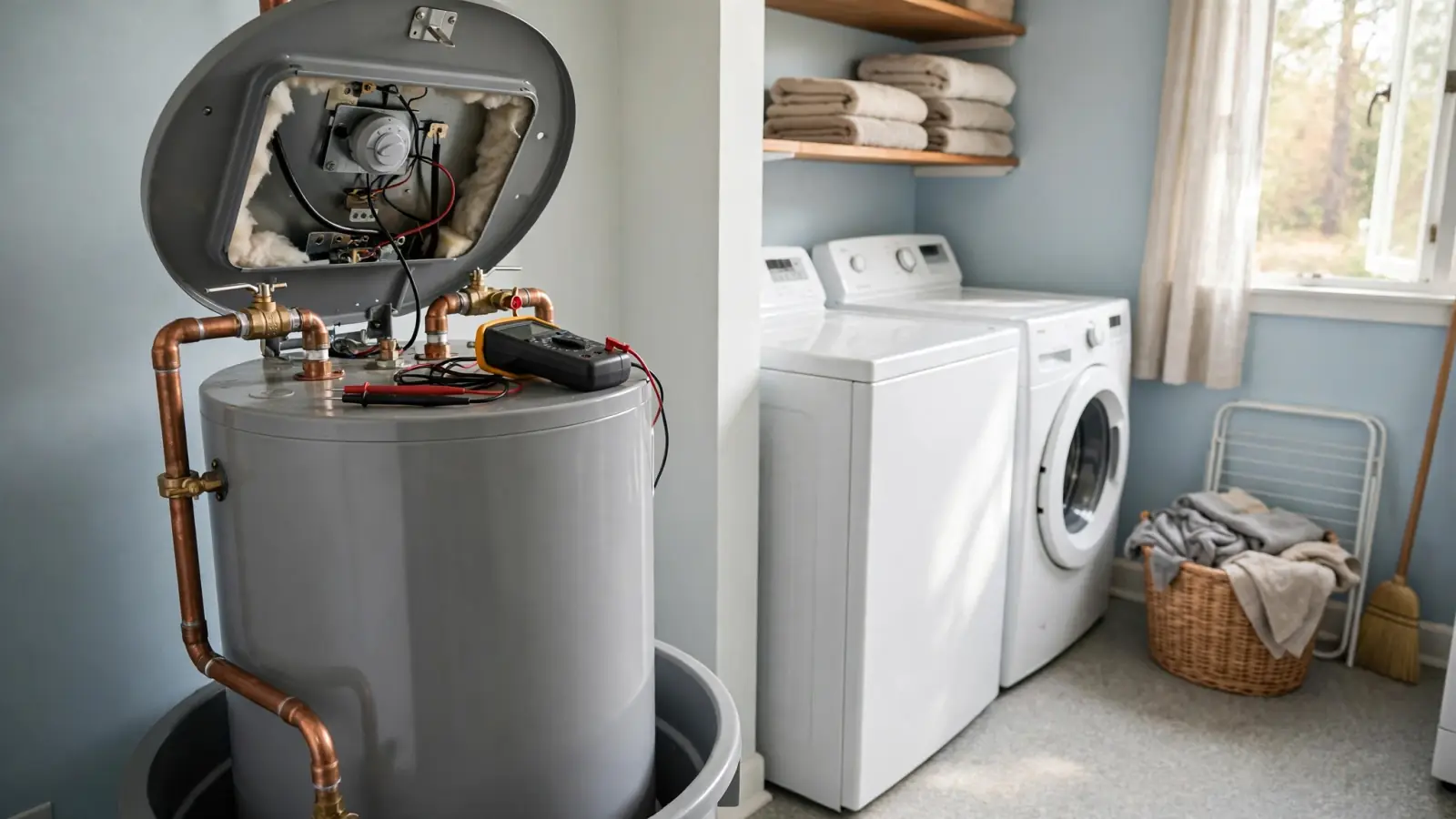
Key facts: Heating Element & Thermostat Replacement
- Most electric tank heaters have an upper and a lower element, each with its own thermostat, and only one heats at a time.
- No hot water at all usually means the upper element or upper thermostat; hot water that runs out fast usually means the lower element.
- A reset button that keeps tripping means the water is overheating, often from a stuck thermostat or shorted element.
- The tank must be completely full before power is restored, or a new element can burn out in seconds [1].
Warning signs
Signs an element or thermostat has failed
Cold tank, breaker on
With power present, a failed upper element or upper thermostat means the lower element never gets its turn, so the whole tank stays cold.
Hot water gone in minutes
Only the top of the tank is heating. A failed lower element or lower thermostat is the usual cause.
High-limit switch tripping
The high-limit switch is detecting overheating, often because a thermostat is stuck closed or an element has shorted to the tank.
Breaker trips
An element shorted to ground, a damaged wire or a loose terminal can trip the double-pole breaker. Leave it off and call.
Slow recovery
If the tank takes far longer than before to reheat, one element may be weak, or sediment may be insulating the lower element.
Sizzling or popping
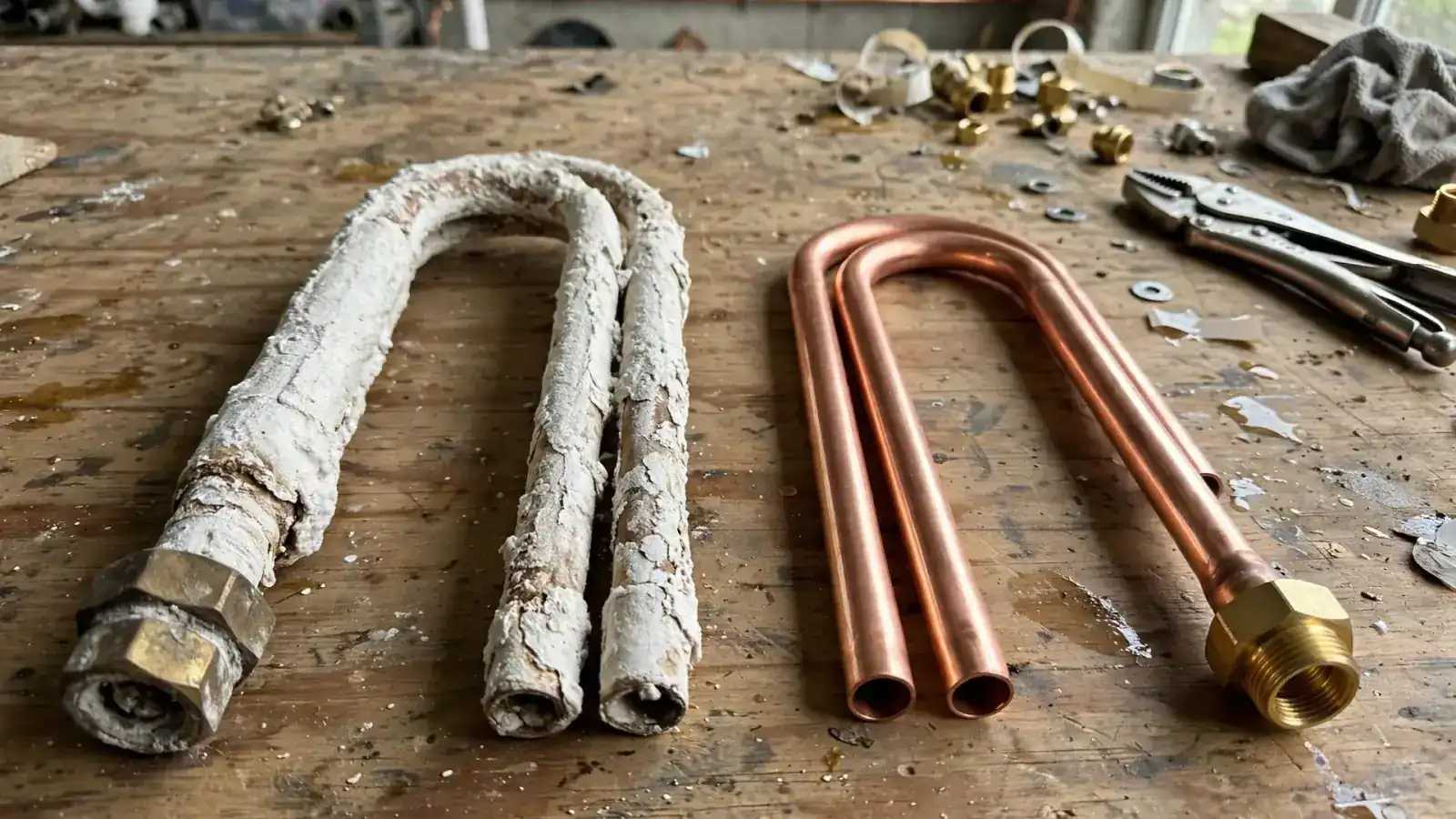
Scale building up on the elements makes them hiss and crackle, shortens their life and reduces efficiency.
Why they fail
Why heating elements and thermostats fail
Elements fail in two main ways. The resistance wire inside can break, so the element simply stops heating; this shows up as an open circuit on a meter. Or the sheath can crack or corrode, letting water reach the wire, which creates a short to the tank. A shorted element often trips the breaker or the high-limit switch rather than quietly failing.
Water quality plays a big part. Minerals settle at the bottom of the tank as sediment and coat the elements as scale. The lower element sits in the thickest sediment, which is why it usually fails first. An element buried in sediment runs hotter than it should, and its sheath wears out faster. In homes with harder water, flushing the tank and choosing a low-watt-density element at replacement can extend element life.
If a tank is drained and the breaker is switched on before it is refilled, the element can burn out in seconds. This 'dry firing' is a common mistake after DIY draining and the reason professionals always refill and purge air from the tank before restoring power.
Thermostats fail less often but wear out mechanically. A thermostat can stick open, so its element never receives power, or stick closed, so its element keeps heating past the setting until the high-limit switch trips. Loose wiring at the thermostat terminals can overheat, discolor the plastic and eventually stop working, which is also a fire risk.
Testing
How elements and thermostats are tested safely
Testing combines power-off checks and carefully controlled live checks, so it is best done by a qualified professional.
- 1
Check supply and breaker
Confirm the double-pole breaker is on, the circuit delivers 240 volts at the heater and there is no heat damage to wiring.
- 2
Power off, test elements
With the breaker off and confirmed dead, each element is disconnected and tested for continuity and for any short to the tank.
- 3
Test thermostats
Each thermostat is checked to see whether it switches power to its element as the water cools and stops when the setting is reached.
- 4
Inspect the high limit
If the reset had tripped, the cause of the overheat is found before the reset is pressed again or replaced.
Diagnose it
Symptom, likely cause and fix
| What you notice | Most likely cause | Typical fix |
|---|---|---|
| No hot water, breaker on | Upper element or upper thermostat | Replace the failed part; test the other side too |
| Hot water runs out after a few minutes | Lower element or lower thermostat | Replace the lower element; flush sediment |
| Water too hot, reset trips | Thermostat stuck closed or element shorted | Replace the faulty thermostat or element, then the high limit if damaged |
| Breaker trips when heater runs | Element shorted to ground or wiring fault | Replace element; repair terminals and wiring |
| Lukewarm water that never gets hot | Thermostats set low, or one element weak | Adjust settings; test and replace weak element |
The job
How an element is replaced
- 1
Power off and lock out
The breaker is switched off and the wires at the heater are confirmed dead before any panel is opened.
- 2
Drain below the element
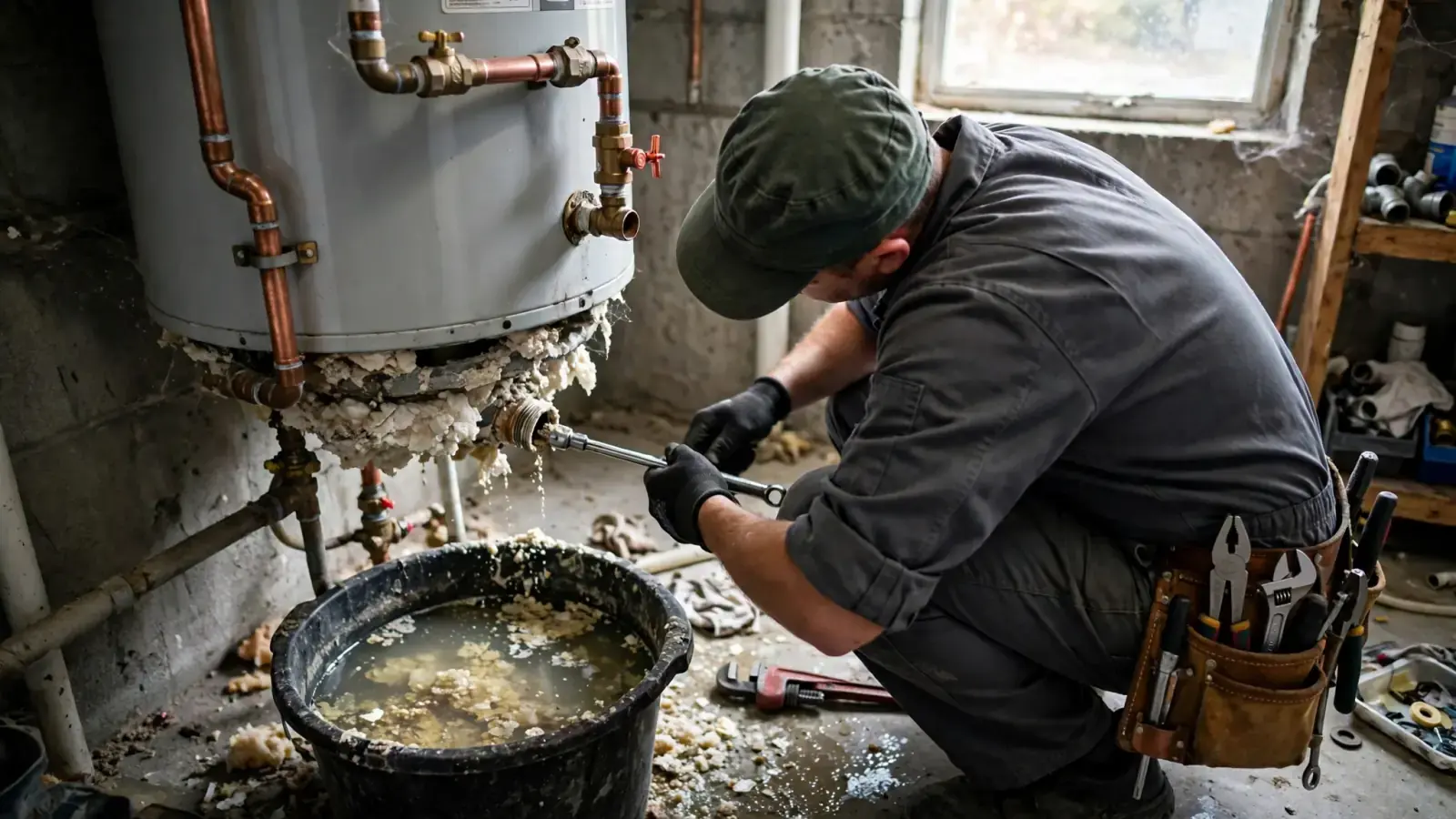
The cold supply is closed and the tank drained to below the element being changed; for the lower element this means nearly empty.
- 3
Swap the element
The old element is unscrewed with an element wrench and a new one of the correct voltage and wattage is installed with a new gasket.
- 4
Refill, purge, power up
The tank is refilled until hot taps run without air, checked for leaks, and only then is power restored and the heater tested.
Element types
Choosing the right replacement element
Elements look similar but differ in ways that matter for life span and safety.
| Type | What it is | Good fit when |
|---|---|---|
| Standard (high watt density) | Compact element that concentrates heat in a short sheath | Soft or average water, matching the original part |
| Low watt density | Longer or folded element that spreads the same power over more surface | Harder water or a history of burned-out elements |
| Stainless or coated sheath | Sheath material more resistant to corrosion | Aggressive or softened water that attacks copper |
| Correct voltage and wattage | Must match the heater's rating plate and circuit | Always; a mismatch overloads wiring or heats poorly |
Settings
Getting the thermostat settings right
Each thermostat on a dual-element heater has its own dial or screw adjustment behind the access panel. They should be set to the same temperature. If the upper thermostat is set much lower than the lower one, the heater may deliver lukewarm water even though nothing is broken; if the upper one is set much higher, the top of the tank can run hotter than intended.
For most households a setting around 120°F balances comfort, safety and energy use. Higher settings increase the risk of scalding, especially for children and older adults, and raise standby losses. If you need hotter water for a specific appliance or health reason, ask about a mixing valve at the heater so the tank can store hotter water while the taps deliver a safe temperature.
After any element or thermostat repair, check the delivered temperature at a kitchen or bathroom tap with a thermometer once the tank has fully recovered, then adjust both dials to match if needed.
Heater types
Single-element, dual-element and other electric heaters
| Heater type | Element setup | What fails most |
|---|---|---|
| Standard dual-element tank | Upper and lower elements, two thermostats, one high limit | Lower element in sediment; thermostats with age |
| Single-element tank | One lower element and thermostat, common in small or point-of-use tanks | The single element; any failure means no hot water |
| Heat pump water heater | Compressor plus backup elements for high demand | Backup elements less often; filters, fans and sensors more often |
| Electric tankless | Several elements in a compact heat exchanger, fired on demand | Elements and flow sensors, especially with scale |
Safety
Electrical safety around a water heater
An electric water heater draws a large current on a dedicated 240-volt circuit. Both legs of that circuit are live, so switching off a single-pole breaker or the wrong breaker leaves dangerous voltage at the heater. Professionals confirm the circuit is dead with a meter at the heater itself before touching any terminal, and they keep the insulation and plastic safety covers in place when the panels are reinstalled.
Signs of an electrical problem that needs attention right away include a burning smell near the heater, discolored or melted plastic at the thermostat, a breaker that is warm to the touch, or repeated tripping. Switch the breaker off and leave it off until the heater has been inspected.
Do it yourself?
What you can check, and where to stop
- Look at the breaker firstReset a tripped double-pole breaker once. If it trips again, leave it off.
- Try the red reset button onceWith the breaker off, remove the upper panel and insulation and press the red reset button, then restore power and wait.
- Confirm the thermostat dialsThermostats are often set by the factory; around 120°F suits most households [2].
- Leave live testing to a proTesting thermostats with power on, changing elements and repairing wiring involve 240 volts and should be done by a qualified professional.
The visit
What to expect during the repair
Expect the plumber to ask whether you have no hot water or simply less than before, how old the heater is and whether the breaker or reset has tripped. Those three answers often point straight to the upper or lower side of the heater. Clear access to the heater and a route for a drain hose to a floor drain or outdoors makes the job faster.
After the electrical tests identify the failed part, the tank is drained to the right level, the part replaced and the tank refilled. A careful technician purges the air through a hot tap, checks the new gasket for leaks and only then restores power. Recovery takes time: a full tank of cold water can take an hour or more to heat, so plan around that.
If the drained water comes out full of sediment, or the old element is heavily scaled, ask about flushing the tank at the same visit. It is the most effective way to protect the new element.
Los Angeles
Electric heaters in Los Angeles homes
In Los Angeles, electric tank heaters are most common in condos and apartments, accessory dwelling units behind houses, and homes without a convenient gas line. Many sit in interior closets, which makes a drain pan with a real drain line, and quick attention to any drip, more important than in a garage.
Water hardness varies across the city because supplies are blended from several sources, so element life can differ noticeably between neighborhoods. California's energy policy also increasingly favors heat pump water heaters, which use far less electricity than standard elements; if an electric tank is old and failing repeatedly, it is worth discussing whether a heat pump unit fits the space [3].
Accessory dwelling units are a special case. Many were added with a small electric tank sized for one or two people and a circuit shared or tightly sized with the rest of the building. If an ADU heater keeps tripping its breaker or runs out of hot water, the fix may involve the circuit or the tank size, not only the element.
Prevention
Making elements last longer
- Flush sediment from the tank as the manual recommends, more often in hard water.
- Never switch the breaker on while the tank is drained or partly empty.
- Choose low-watt-density elements when replacing in hard-water homes.
- Have terminals checked for tightness and heat discoloration during service visits.
- Keep the temperature at a moderate setting rather than the maximum.
Repair or replace
Is an element repair worth it?
The exceptions are a tank leaking from its shell, rust in the hot water from an old tank, or a heater that has burned through several elements because of heavy, hardened sediment that will not flush out.
Replacing on your own schedule also avoids the risk of a closet heater failing suddenly and leaking into finished rooms.
Related problems
When the element is not the culprit
Several problems mimic a failed element. A broken dip tube, the plastic pipe that carries incoming cold water to the bottom of the tank, lets cold water mix straight into the hot outlet, so the heater seems to run out quickly even though both elements work. Sediment can make the tank behave as if it were much smaller than its rating. A mixing or anti-scald valve set low at a shower makes one fixture lukewarm while the rest of the house is fine.
On the electrical side, a worn breaker can fail to pass power on one leg, and a loose connection in the junction box at the top of the heater can cut power intermittently. A systematic test from the panel to each element is what separates these from a simple element failure, and it is the reason a good technician measures before replacing.
Element types
Choosing a replacement element
Replacement elements must match the voltage and wattage printed on the heater's rating plate. Installing a higher-wattage element than the heater and its circuit were designed for can overheat wiring and trip breakers, so a plumber always matches the original rating.
Elements also come in different styles. Low-watt-density elements spread the same power over a longer, folded surface, which runs cooler and resists scale buildup in hard water. Stainless or coated elements resist corrosion better than plain copper ones. In homes with hard water or repeated element failures, these options are worth asking about.
FAQ
Element and thermostat questions
How do I know if my water heater element is bad?
No hot water at all suggests the upper element or thermostat; hot water that runs out quickly suggests the lower element. A plumber confirms it with a continuity test after switching off the power.
How long do water heater elements last?
Heating element life varies widely with water quality and sediment. In soft water elements can last many years; in hard water with heavy sediment, the lower element can fail much sooner.
Can I replace a water heater element without draining the tank?
The water level must be below the element, so at least partial draining is needed. Removing an element under water would flood the area.
Why does my water heater reset button keep tripping?
The high-limit switch trips when water overheats. A thermostat stuck closed or an element shorted to the tank are common causes, and both need repair rather than repeated resetting.
Should both elements be replaced at once?
Not necessarily. Each is tested separately. If both are old and scaled, replacing both while the tank is drained can save a second visit.
What wattage element do I need?
The one listed on the heater's rating plate. Installing a higher-wattage element than the circuit is designed for can overload the wiring.
Is it dangerous to work on an electric water heater?
Yes. It operates on 240 volts. Testing and replacing parts should be done with the power confirmed off and by someone qualified to work on it.
How long until I have hot water after the repair?
A full tank of cold water commonly takes an hour or more to heat, depending on tank size and element wattage.
Why is my electric water heater only lukewarm?
The thermostats may be set low or mismatched, one element may be weak, or sediment may be insulating the lower element. Testing both sides and checking the settings usually finds the cause.
Can a bad element trip the breaker?
Yes. An element with a cracked sheath can short to the tank and trip the breaker or the high-limit switch. It should be replaced, not reset repeatedly.
Does a new element make the heater more efficient?
A new element restores normal heating. Efficiency depends more on sediment, tank insulation and the temperature setting, and a heat pump water heater is far more efficient than any element.
Do I need a permit to replace a water heater element?
Replacing an element or thermostat is a repair and normally does not need a permit. Replacing the whole heater is permitted work in the City of Los Angeles.
Can I use a higher-wattage element for faster heating?
No. The element must match the voltage and wattage on the rating plate. A higher rating can overload the wiring and circuit.
How do I know which element failed?
No hot water at all points to the upper element or thermostat; a short burst then lukewarm points to the lower element. Testing confirms it.
Is a burnt smell from the panel serious?
Yes. Turn the breaker off and leave it off until a professional inspects the wiring and terminals.